Skip to main content
General Biology
My Course
Learn
Exam Prep
AI Tutor
Study Guides
Textbook Solutions
Flashcards
Explore
Try the app
My Course
Learn
Exam Prep
AI Tutor
Study Guides
Textbook Solutions
Flashcards
Explore
Try the app
Back
General Biology: Cell Biology and Biochemistry Study Guide
You can tap to flip the card.
What determines the properties of organic compounds?
You can tap to flip the card.
👆
What determines the properties of organic compounds?
The size and shape of the carbon skeleton and the atoms attached to it.
Track progress
Control buttons has been changed to "navigation" mode.
1/34
Recommended videos
02:00
Functional Groups Example 1
19207
views
398
rank
1
comments
06:04
Functional Groups
27978
views
586
rank
1
comments
Terms in this set (34)
Hide definitions
What determines the properties of organic compounds?
The size and shape of the carbon skeleton and the atoms attached to it.
What is a chemical group?
Atoms attached to the carbon skeleton that affect the function of a molecule.
Example of molecules with the same carbon skeleton but different chemical groups?
Testosterone and estradiol.
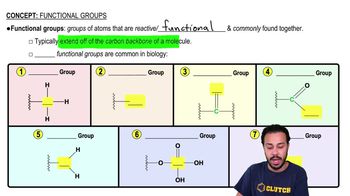
What is a hydroxyl group and where is it found?
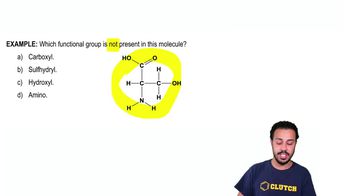
A hydrogen atom attached to an oxygen atom (-OH); found in alcohols.
What is a carbonyl group and where is it found?
A carbon atom double bonded to oxygen; found in simple sugars.
What is a carboxyl group and its chemical property?
A carbon double bonded to oxygen and bonded to hydroxyl (-COOH); donates H+, making it acidic.
What is an amino group and its function?
Nitrogen bonded to two hydrogens (-NH2); picks up H+ from solution, forming amines.
Which chemical groups are polar and hydrophilic?
Hydroxyl, carbonyl, carboxyl, amino, and phosphate groups.
Which chemical group is non-polar, hydrophobic, and non-reactive?
The methyl group (-CH3).
What are the four main classes of macromolecules?
Carbohydrates, lipids, proteins, and nucleic acids.
What is a polymer?
A long molecule made of many similar or identical monomers linked in a chain.
What is a dehydration reaction?
A reaction that removes water to bond two molecules together; requires enzymes.
What is hydrolysis?
The digestion of polymers into monomers by adding water; requires enzymes.
Are most carbohydrates hydrophilic or hydrophobic?
Hydrophilic, due to many hydroxyl groups.
What is the general formula for monosaccharides?
A multiple of CH2O, e.g. glucose is C6H12O6.
What are polysaccharides and their function?
Hundreds or thousands of monosaccharides linked; function as storage and structural molecules.
What is starch and its function in plants?
A storage polysaccharide that coils into a helical shape; serves as carbohydrate storage.
What is glycogen?
A highly branched glucose storage polysaccharide in animals, mainly in liver and muscle cells.
What is cellulose?
A glucose polymer forming cable-like microfibrils; major component of plant cell walls.
What is chitin and where is it found?
A structural polysaccharide in insect and crustacean exoskeletons and fungal cell walls.
Are lipids hydrophobic or hydrophilic?
Hydrophobic; they do not mix well with water.
What are the three important types of lipids?
Fats, phospholipids, and steroids.
What is a fat (triglyceride)?
Three fatty acids linked to a glycerol molecule.
Difference between saturated and unsaturated fatty acids?
Saturated have no double bonds and are solid at room temperature; unsaturated have double bonds and are liquid.
What is the main function of fats?
Energy storage, storing twice as much energy per gram as carbohydrates.
What is the structure and role of phospholipids in membranes?
Glycerol, two fatty acids (hydrophobic tails), and a phosphate group (hydrophilic head); form bilayers in membranes.
What is a protein?
A polymer made of amino acid monomers.
What are the 8 roles of proteins?
Enzymes, transport, defense, signaling, receptors, contractile, structural, and storage proteins.
What is a peptide bond?
A covalent bond formed by dehydration between amino and carboxyl groups of amino acids.
What are the four levels of protein structure?
Primary (sequence), secondary (local folding), tertiary (3D shape), quaternary (multiple polypeptides).
What is denaturation?
Loss of protein shape and function due to environmental factors like heat.
What are nucleotides?
Monomers of nucleic acids, composed of a 5-carbon sugar, phosphate group, and nitrogenous base.
Base pairing rules in DNA?
Adenine pairs with thymine; guanine pairs with cytosine via hydrogen bonds.
What is ATP and why is it an energy carrier?
Adenosine triphosphate stores energy in its negatively charged phosphate bonds, which release energy when hydrolyzed.
 BackBack
 02:00