Skip to main content
General Biology
My Course
Learn
Exam Prep
AI Tutor
Study Guides
Textbook Solutions
Flashcards
Explore
Try the app
My Course
Learn
Exam Prep
AI Tutor
Study Guides
Textbook Solutions
Flashcards
Explore
Try the app
Back
General Biology: Cell Cycle and Meiosis
You can tap to flip the card.
What is the primary result of most cell division?
You can tap to flip the card.
👆
What is the primary result of most cell division?
Most cell division results in genetically identical daughter cells, ensuring continuity of life.
Track progress
Control buttons has been changed to "navigation" mode.
1/30
Recommended videos
04:45
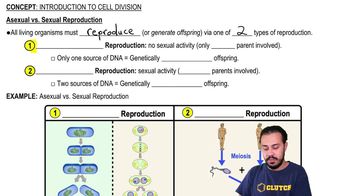
Asexual vs. Sexual Reproduction
18644
views
392
rank
3
comments
09:40
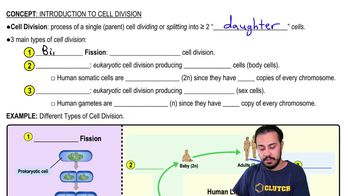
Introduction to Cell Division
28297
views
638
rank
1
comments
03:19
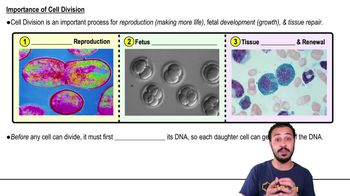
Importance of Cell Division
17847
views
576
rank
1
comments
Terms in this set (30)
Hide definitions
What is the primary result of most cell division?
Most cell division results in genetically identical daughter cells, ensuring continuity of life.
What are the key roles of cell division in multicellular eukaryotes?
Cell division allows growth, development, renewal, and repair in multicellular eukaryotes.
How is genetic material organized in prokaryotes versus eukaryotes?
Prokaryotes have a single circular chromosome; eukaryotes have multiple linear chromosomes.
What is the difference between chromatin and chromosomes?
Chromatin
is unpacked DNA accessible for use;
chromosomes
are condensed DNA packaged for cell division.
What are germ line cells and somatic cells?
Germ line cells are diploid progenitors that produce haploid gametes by meiosis; somatic cells are all other diploid body cells.
What is the difference between haploid and diploid cells?
Haploid cells contain one copy of each chromosome; diploid cells contain two copies of each chromosome.
What is the cell cycle and its main phases?
The cell cycle includes interphase (G1, S, G2 phases) and M phase (mitosis and cytokinesis).
What happens during the S phase of the cell cycle?
DNA is replicated in preparation for cell division.
What are the five stages of mitosis?
Prophase, prometaphase, metaphase, anaphase, and telophase.
What occurs during prophase in mitosis?
Chromatin condenses into chromosomes, nucleoli disappear, mitotic spindle forms, and centrosomes migrate.
What is the mitotic spindle and its function?
A structure of microtubules that controls chromosome movement during mitosis.
What happens during metaphase of mitosis?
Chromosomes align at the metaphase plate, each attached to spindle microtubules from opposite poles.
Describe anaphase in mitosis.
Sister chromatids separate and are pulled to opposite poles as kinetochore microtubules shorten.
What occurs during telophase and cytokinesis?
Nuclear envelope reforms, chromosomes decondense, and the cell divides into two daughter cells.
How does cytokinesis differ in animal and plant cells?
Animals form a cleavage furrow using actin and myosin; plants form a cell plate from Golgi vesicles.
What is binary fission in prokaryotes?
A form of asexual reproduction where the single chromosome replicates and the cell divides into two identical cells.
What controls progression through the cell cycle?
Checkpoints regulated by proteins monitor DNA integrity and spindle formation to control cell cycle progression.
What happens if DNA damage is detected at the G1 checkpoint?
The cell attempts repair; if unsuccessful, it may undergo apoptosis (programmed cell death).
How can loss of cell cycle control lead to cancer?
Disruption of checkpoints allows uncontrolled cell division, leading to tumor formation.
What are oncogenes and tumor-suppressor genes?
Oncogenes promote cell growth when hyperactive; tumor-suppressor genes inhibit growth and cause cancer when inactivated.
What is the difference between a benign and malignant tumor?
Benign tumors grow slowly and remain localized; malignant tumors invade other tissues and can metastasize.
What is asexual reproduction?
Reproduction by a single parent producing genetically identical offspring without gamete fusion.
What is sexual reproduction?
Reproduction involving fusion of gametes from two parents, producing genetically diverse offspring.
What is the significance of genetic diversity in sexual reproduction?
Genetic diversity increases the chance of offspring survival in changing environments.
What are homologous chromosomes?
Pairs of chromosomes similar in length and gene content, one from each parent.
What is meiosis and its purpose?
A type of cell division that reduces chromosome number from diploid to haploid to produce gametes.
What occurs during prophase I of meiosis?
Homologous chromosomes pair (synapsis) and crossing over occurs, increasing genetic variation.
What is independent assortment in meiosis?
Random orientation of chromosome pairs at metaphase I, producing diverse gamete combinations.
How does crossing over contribute to genetic variation?
Exchange of DNA segments between non-sister chromatids creates recombinant chromosomes.
What is random fertilization?
Any sperm can fuse with any egg, increasing genetic variation in offspring.
 BackBack
 04:45