 Back
BackGeneral Biology: Cell Domains, Elements, and Chemical Bonds
 04:39
04:39
Terms in this set (30)
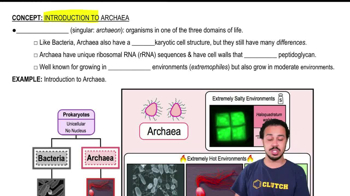
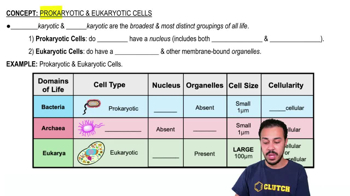
Bacteria, Archaea, and Eukarya include unicellular organisms.
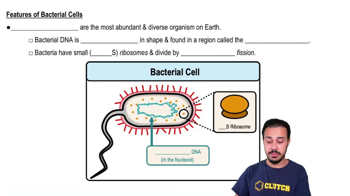
Bacteria and Archaea are composed of prokaryotic cells.
Fungi belong to the domain Eukarya.
Kingdoms Plantae, Fungi, Animalia, and diverse Protists are in domain Eukarya.
An element is a substance that cannot be chemically broken down into a simpler substance.
A compound is a substance made of two or more elements combined in a fixed ratio.
Emergent properties are new characteristics that arise at higher levels of biological organization.
Oxygen (65%), Carbon (18.5%), Hydrogen (9.5%), and Nitrogen (3.3%).
Trace elements are required in small amounts; examples include Iron (for hemoglobin) and Zinc (for immune function).
Protons: positive, nucleus; Neutrons: neutral, nucleus; Electrons: negative, electron shells.
The number of protons in the nucleus determines the element's identity.
Isotopes are atoms of the same element with different numbers of neutrons.
A radioactive isotope is unstable and emits energy and particles as it decays.
They can form ionic bonds (electron transfer), covalent bonds (electron sharing), and hydrogen bonds.
A covalent bond involves sharing of electron pairs between atoms.
Polar covalent bonds share electrons unequally, creating partial charges; nonpolar covalent bonds share electrons equally with no charge separation.
An ionic bond forms when one atom transfers electrons to another, creating oppositely charged ions attracted to each other.
A hydrogen bond is a weak attraction between a slightly positive region of one molecule and a slightly negative region of another.
The innermost electron shell can hold up to 2 electrons.
The number of electrons in the outermost shell determines an atom's chemical reactivity.
A molecule is two or more atoms held together by covalent bonds.
An ion is an atom or molecule with a net electric charge due to loss or gain of electrons.
A neutral solution has equal concentrations of H+ and OH- ions.
A buffer is a substance that accepts H+ when in excess and donates H+ when their concentration drops, stabilizing pH.
The atomic number is 6, equal to the number of protons.
Fluorine has 10 neutrons (19 - 9 = 10).
The highest level is the Domain.
All members are prokaryotic, lacking a nucleus and membrane-bound organelles.
The scientific method is an approach for understanding natural phenomena through observation and experimentation.
A hypothesis is a tentative explanation for an observation or set of observations.