Skip to main content
General Biology
My Course
Learn
Exam Prep
AI Tutor
Study Guides
Textbook Solutions
Flashcards
Explore
Try the app
My Course
Learn
Exam Prep
AI Tutor
Study Guides
Textbook Solutions
Flashcards
Explore
Try the app
Back
General Biology: Cell Membranes and Energy
You can tap to flip the card.
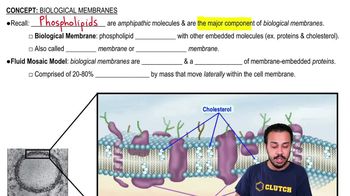
Fluid mosaic model
You can tap to flip the card.
👆
Fluid mosaic model
Describes the membrane structure as a fluid phospholipid bilayer with diverse protein molecules suspended within it.
Track progress
Control buttons has been changed to "navigation" mode.
1/29
Recommended videos
Guided course
02:21
Biological Membranes Example 1
19704
views
356
rank
1
comments
Guided course
06:04
Biological Membranes
27083
views
501
rank
2
comments
Terms in this set (29)
Hide definitions
Fluid mosaic model
Describes the membrane structure as a fluid phospholipid bilayer with diverse protein molecules suspended within it.
Three general functions of the plasma membrane
Physical barrier
,
cell signaling
, and
transport
.
Selective permeability
The plasma membrane's ability to allow some substances to cross more easily than others.
Diffusion
The tendency of particles to spread out evenly in an available space without energy input.
Passive transport
Diffusion across a membrane that requires no energy.
Osmosis
The diffusion of water across a selectively permeable membrane.
Tonicity
Describes the ability of a surrounding solution to cause a cell to gain or lose water.
Hypertonic solution effect on cells
Cells shrink as water leaves the cell.
Hypotonic solution effect on cells
Cells swell as water enters the cell.
Isotonic solution effect on cells
Animal cells remain normal; plant cells become flaccid.
Facilitated diffusion
Transport of polar or charged substances across membranes with the help of specific transport proteins without energy input.
Aquaporins
Protein channels that facilitate rapid diffusion of water into and out of certain cells.
Active transport
Energy-requiring process that moves solutes against their concentration gradient using ATP.
Exocytosis
Process used by cells to export bulky molecules by packaging them in vesicles that fuse with the membrane.
Endocytosis
Process used by cells to take in large molecules by engulfing them in vesicles.
Phagocytosis
A type of endocytosis where the cell engulfs a particle by wrapping its membrane around it, forming a vacuole.
Receptor-mediated endocytosis
Endocytosis that uses membrane receptors to take in specific solutes.
Kinetic energy
Energy of motion.
Potential energy
Energy stored in the location or structure of matter, including chemical energy.
First law of thermodynamics
Energy can change form but cannot be created or destroyed.
Second law of thermodynamics
Energy transfers increase disorder (entropy), with some energy lost as heat.
Exergonic reactions
Chemical reactions that release energy.
Endergonic reactions
Chemical reactions that require energy and yield products rich in potential energy.
ATP function
Powers nearly all forms of cellular work by transferring phosphate groups.
Enzymes
Catalysts that lower activation energy needed for reactions without being consumed.
Active site
Region of an enzyme where the substrate specifically fits.
Competitive inhibitor
Molecule that reduces enzyme productivity by blocking substrate binding at the active site.
Noncompetitive inhibitor
Binds elsewhere on the enzyme, changing its shape so the active site no longer fits the substrate.
Feedback inhibition
Regulation of metabolism where the end product inhibits an earlier step in the pathway.
 BackBack
 02:21
02:21