Skip to main content
General Biology
My Course
Learn
Exam Prep
AI Tutor
Study Guides
Textbook Solutions
Flashcards
Explore
Try the app
My Course
Learn
Exam Prep
AI Tutor
Study Guides
Textbook Solutions
Flashcards
Explore
Try the app
Back
General Biology: Cell Membranes and Transport
You can tap to flip the card.
Structural components of membranes
You can tap to flip the card.
👆
Structural components of membranes
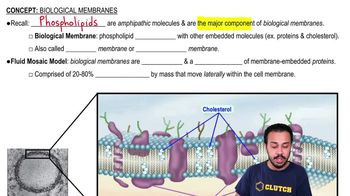
Membranes are mainly composed of a phospholipid bilayer, proteins, cholesterol, and carbohydrates.
Track progress
Control buttons has been changed to "navigation" mode.
1/17
Recommended videos
02:21
Biological Membranes Example 1
24681
views
457
rank
1
comments
06:04
Biological Membranes
33826
views
687
rank
2
comments
Terms in this set (17)
Hide definitions
Structural components of membranes
Membranes are mainly composed of a phospholipid bilayer, proteins, cholesterol, and carbohydrates.
Functional benefits of membrane-bound compartments
They allow specialization of cellular processes and maintain distinct environments for different biochemical reactions.
Roles of proteins in membranes
Membrane proteins function in transport, signal transduction, cell recognition, and structural support.
Membrane permeability for polar vs nonpolar molecules
Nonpolar molecules pass easily through membranes, while polar molecules require specific transport proteins.
Movement of molecules from high to low concentration
This passive movement is called diffusion and occurs down the concentration gradient.
Diffusion vs osmosis
Diffusion is the movement of solutes; osmosis is the diffusion of water across a selectively permeable membrane.
Hypotonic solution effect on animal cells
Water enters the cell, causing it to swell and possibly burst (lysis).
Isotonic solution effect on cells
Water moves in and out at equal rates, so cell size remains stable.
Hypertonic solution effect on plant cells
Water leaves the cell, causing the cell membrane to pull away from the cell wall (plasmolysis).
Active transport across membranes
Active transport uses energy to move substances against their concentration gradient.
Energy requirements: passive vs active transport
Passive transport requires no energy; active transport requires ATP or another energy source.
Active transport of large vs small substances
Small molecules use protein pumps; large substances use vesicle-mediated processes like endocytosis.
Role of the extracellular matrix (ECM) in animal cells
The ECM provides structural support and influences cell behavior and communication.
Adhesion junctions in animal cells
They connect the cytoskeletons of adjacent cells, providing mechanical stability.
Tight junctions in animal cells
They create a seal that prevents leakage of extracellular fluid between cells.
Gap junctions in animal cells
They allow direct communication by permitting the passage of ions and small molecules.
Cell-to-cell junctions in plants vs animals
Plants have plasmodesmata for communication; animals have adhesion, tight, and gap junctions.
 BackBack
 02:21