 Back
General Biology: Cell Membranes and Transport
 02:21

Terms in this set (28)
The plasma membrane separates the living cell from its surroundings and controls traffic into and out of the cell, allowing selective exchange of substances.
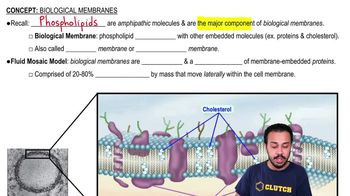
The membrane is a fluid structure with a mosaic of proteins embedded in or attached to a phospholipid bilayer, allowing lateral movement of molecules.
Phospholipids arrange with hydrophobic fatty acid tails inward, shielded from water, and hydrophilic phosphate heads facing outward toward water.
Membrane fluidity is influenced by temperature, lipid composition (unsaturated vs saturated fatty acids), and cholesterol acting as a fluidity buffer.
Integral proteins penetrate the hydrophobic bilayer, often spanning it; peripheral proteins are loosely bound to membrane surfaces.
Transport, enzymatic activity, signal transduction, cell-cell recognition, intercellular joining, and attachment to cytoskeleton and extracellular matrix.
Carbohydrates on membrane glycoproteins and glycolipids aid in cell-cell recognition and immune response.
Membranes allow some substances to cross more easily than others, depending on molecule polarity and size, and presence of transport proteins.
Diffusion of substances across membranes without energy input, moving down their concentration gradient.
Passive diffusion of water across a selectively permeable membrane from lower to higher solute concentration until equilibrium.
Isotonic: no net water movement; hypertonic: cell loses water and shrivels; hypotonic: cell gains water and may lyse.
Passive transport aided by transport proteins like channel and carrier proteins, specific for certain molecules.
Channel proteins that greatly increase the rate of water diffusion across membranes.
Movement of solutes against their concentration gradient using energy (ATP) and carrier proteins.
Active transport pump exchanging 3 Na+ out and 2 K+ in, maintaining ion gradients and membrane potential.
Voltage across a membrane due to unequal ion distribution; inside of cell is negative relative to outside.
Combined chemical and electrical forces driving ion diffusion across membranes.
Transport proteins that generate voltage across membranes, e.g., sodium-potassium pump in animals and proton pump in plants.
Active transport where a pump creates a gradient that drives the transport of another solute against its gradient via a coupled protein.
Vesicle fusion with plasma membrane to export large molecules or particles out of the cell.
Process of engulfing substances by forming vesicles from the plasma membrane to bring materials into the cell.
Phagocytosis (cell eating), pinocytosis (cell drinking), and receptor-mediated endocytosis (specific uptake via receptors).
Inherited disease caused by defective LDL receptors, leading to cholesterol buildup and early atherosclerosis.
Membranes have distinct inside and outside faces with different lipid and protein compositions determined during synthesis in ER and Golgi.
Lipids and some proteins move laterally rapidly; flip-flop between layers is rare; some proteins are anchored and immobile.
Cholesterol stabilizes membrane fluidity by restraining phospholipid movement at high temperatures and preventing tight packing at low temperatures.
Membrane proteins are amphipathic with hydrophobic and hydrophilic regions, embedded within the bilayer rather than only on the surface.
Method that splits membranes along the phospholipid bilayer, revealing proteins embedded in the membrane, supporting the fluid mosaic model.