The cell is the simplest collection of matter that can be alive and is the basic unit of structure and function in all organisms.
What are the main differences between prokaryotic and eukaryotic cells?
Prokaryotic cells lack a nucleus and membrane-bound organelles; DNA is in the nucleoid. Eukaryotic cells have a nucleus and membrane-bound organelles.
What is magnification in microscopy?
Magnification is the ratio of an object’s image size to its real size, with light microscopes magnifying up to about 1,000 times.
Define resolution in microscopy.
Resolution is the minimum distance two points can be separated and still be distinguished as separate; light microscopes have about 200 nm resolution.
How do electron microscopes (EM) differ from light microscopes (LM)?
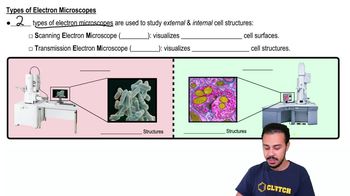
EMs use electron beams with shorter wavelengths for higher resolution (~2 nm practical limit), allowing visualization of organelles; LMs use visible light and can view live cells.
What is cell fractionation and its purpose?
Cell fractionation separates cell components by centrifugation to isolate organelles for studying their specific functions.
What is the plasma membrane and its function?
The plasma membrane is a selective barrier surrounding all cells, regulating passage of oxygen, nutrients, and wastes.
Why is the surface area to volume ratio important for cells?
Smaller cells have a higher surface area to volume ratio, allowing efficient chemical exchange; large cells risk inadequate exchange.
What is the endomembrane system?
A network of membranes including the nuclear envelope, ER, Golgi apparatus, lysosomes, vesicles, vacuoles, and plasma membrane that regulate protein traffic and metabolism.
Describe the difference between rough and smooth endoplasmic reticulum (ER).
Rough ER has ribosomes and synthesizes proteins; smooth ER lacks ribosomes and synthesizes lipids, detoxifies drugs, and stores calcium ions.
What is the function of the Golgi apparatus?
The Golgi apparatus modifies, sorts, and ships proteins and lipids received from the ER to their destinations.
What are lysosomes and their role?
Lysosomes are membrane-bound sacs of hydrolytic enzymes that digest macromolecules and recycle cellular components.
What functions do vacuoles serve in cells?
Vacuoles store nutrients, waste, pigments, and help maintain cell size and pressure; contractile vacuoles expel excess water in protists.
What is the endosymbiont theory?
It proposes that mitochondria and chloroplasts originated from engulfed prokaryotic cells that became symbiotic within early eukaryotes.
Describe the structure and function of mitochondria.
Mitochondria have a double membrane with inner folds called cristae; they generate ATP through cellular respiration.
What are chloroplasts and their main function?
Chloroplasts contain chlorophyll and thylakoids; they convert solar energy into chemical energy via photosynthesis.
What is the cytoskeleton and its main roles?
The cytoskeleton is a network of microtubules, microfilaments, and intermediate filaments that provide support, motility, and regulate cell activities.
What are microtubules and their functions?
Microtubules are hollow tubes made of tubulin that shape the cell, guide organelle movement, and separate chromosomes during cell division.
How do cilia and flagella differ in structure and movement?
Both have a '9 + 2' microtubule arrangement; cilia move with oar-like strokes perpendicular to their axis, flagella move with undulating motion along their axis.
What are microfilaments and their role in cells?
Microfilaments are actin filaments that bear tension, support cell shape, enable muscle contraction, and drive cell motility.
What are intermediate filaments and their function?
Intermediate filaments provide mechanical support, maintain cell shape, and anchor organelles; they are more permanent than other cytoskeletal elements.
What is the plant cell wall composed of and its functions?
Plant cell walls are made of cellulose microfibrils embedded in a matrix; they protect, maintain shape, prevent excess water uptake, and support the plant.
What is the extracellular matrix (ECM) in animal cells?
The ECM is a network of glycoproteins like collagen that supports, adheres, and regulates animal cells.
How do intercellular junctions function in animal tissues?
Tight junctions prevent leakage, desmosomes anchor cells together, and gap junctions allow communication via cytoplasmic channels.
What is the nuclear envelope and its features?
The nuclear envelope is a double membrane with pores that regulate macromolecule passage between nucleus and cytoplasm.
What is chromatin?
Chromatin is DNA and protein complex in the nucleus that condenses into chromosomes during cell division.
What is the nucleolus and its function?
The nucleolus synthesizes ribosomal RNA and assembles ribosomal subunits.
What distinguishes free ribosomes from bound ribosomes?
Free ribosomes synthesize proteins for cytosol use; bound ribosomes make proteins for membranes, organelles, or secretion.
How do motor proteins interact with the cytoskeleton?
Motor proteins like dynein and myosin 'walk' along cytoskeletal fibers to move organelles, vesicles, and enable cell motility.
 Back
 06:35