What is cell-to-cell communication and why is it important?
Cell-to-cell communication allows cells in multicellular organisms to coordinate activities. It is important for both multicellular and unicellular organisms to regulate cellular functions.
What is a signal transduction pathway?
A series of steps by which a signal on a cell’s surface is converted into a specific cellular response inside the cell.
What is quorum sensing in bacteria?
A process where bacteria secrete signaling molecules to detect local cell density, coordinating activities like biofilm formation.
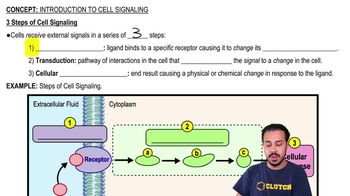
What are the three stages of cell signaling?
Reception (signal binding to receptor), transduction (signal conversion inside the cell), and response (cellular activity triggered).
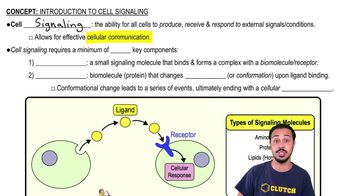
What is a ligand in cell signaling?
A small molecule that binds specifically to a larger receptor molecule, causing a change in the receptor's shape.
Name the three major types of membrane receptors.
G-protein-linked receptors, receptor tyrosine kinases, and ligand-gated ion channels.
How does a G-protein-linked receptor work?
Binding of a signal activates the receptor, causing the associated G protein to exchange GDP for GTP, activating it to regulate an enzyme and trigger a cellular response.
What is receptor tyrosine kinase (RTK) and its function?
A membrane receptor with enzymatic activity that dimerizes upon ligand binding, phosphorylates tyrosines, and activates multiple relay proteins to trigger diverse cellular responses.
How do ligand-gated ion channels function in signaling?
They open or close ion channels in response to ligand binding, allowing ions like Na+ or Ca2+ to flow and alter cell activity.
What distinguishes intracellular receptors from membrane receptors?
Intracellular receptors are inside the cell (cytoplasm or nucleus) and bind hydrophobic or small signaling molecules that can cross the plasma membrane.
What role do transcription factors play in cell signaling?
Activated receptor complexes can act as transcription factors that regulate gene expression by turning specific genes on or off.
What is a phosphorylation cascade in signal transduction?
A series of protein kinases activating one another by phosphorylation, amplifying the signal inside the cell.
What is the role of protein phosphatases in signaling?
They remove phosphate groups from proteins, inactivating them and turning off the signal transduction pathway.
Define second messengers and give two examples.
Small, nonprotein molecules or ions that relay signals inside the cell; examples include cyclic AMP (cAMP) and calcium ions (Ca2+).
How does cyclic AMP (cAMP) function in signaling?
cAMP is produced from ATP by adenylyl cyclase and activates protein kinase A, which phosphorylates target proteins to elicit a response.
What is the significance of calcium ions (Ca2+) as second messengers?
Ca2+ concentration changes trigger various cellular responses like muscle contraction and secretion; cells maintain low cytosolic Ca2+ to allow rapid signaling.
What is the function of scaffolding proteins in signaling pathways?
They organize groups of relay proteins to increase signaling efficiency and specificity by holding components close together.
How do cells ensure specificity in response to the same signal?
Different cell types have distinct sets of receptors, relay proteins, and response proteins, leading to varied responses to the same signal.
What is apoptosis and why is it important?
Programmed cell suicide that removes damaged or unneeded cells, protecting neighboring cells and playing key roles in development and disease prevention.
What are caspases in apoptosis?
Proteases that execute apoptosis by cleaving proteins; key caspases include Ced-3 in nematodes and multiple caspases in mammals.
How is apoptosis regulated in cells?
By signals that activate or inhibit apoptosis proteins like Ced-9, integrating external and internal cues to decide cell survival or death.
What is the role of cytochrome c in apoptosis?
When released from mitochondria, cytochrome c acts as a death factor that promotes the apoptotic cascade.
How can failure of apoptosis contribute to disease?
Insufficient apoptosis can lead to cancer or developmental abnormalities, while excessive apoptosis is linked to degenerative diseases.
What is paracrine signaling?
Local signaling where a cell secretes growth factors that stimulate nearby target cells to grow and multiply.
Describe synaptic signaling.
An electrical signal in a nerve cell triggers neurotransmitter release, which crosses a synapse to stimulate a target cell.
What is the difference between local and long-distance signaling?
Local signaling affects nearby cells via direct contact or local regulators; long-distance signaling uses hormones traveling through circulatory systems.
How do plants differ from animals in local cell signaling?
Plants use plasmodesmata for direct cytoplasmic connections and rely more on diffusion or cell-to-cell transport due to cell walls.
What is the significance of the evolutionary conservation of signaling pathways?
Similar signaling mechanisms across diverse organisms suggest these pathways evolved early and are fundamental to life.
 Back
 05:03