 Back
BackGeneral Biology: Cellular Respiration and Photosynthesis
 04:21
04:21
Terms in this set (28)
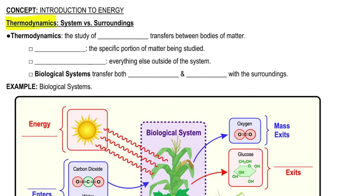
Energy (sunlight) + CO2 + H2O → Organic molecules (sugar) + O2
Organic molecules (sugar) + O2 → CO2 + H2O + Energy (ATP)
Respiration is gas exchange (breathing). Cellular respiration is aerobic harvesting of energy from organic molecules.
Transfer of electrons between reactants; oxidation is loss of electrons, reduction is gain of electrons.
NAD+ is a coenzyme that accepts electrons to become NADH, shuttling electrons in redox reactions.
1. Glycolysis, 2. Pyruvate oxidation and citric acid cycle, 3. Oxidative phosphorylation.
Occurs in the cytosol, breaking glucose into two pyruvate molecules.
ATP production by transferring a phosphate group directly from a substrate to ADP during glycolysis and citric acid cycle.
Uses 2 ATP to energize glucose; produces 4 ATP and 2 NADH; net gain of 2 ATP.
It occurs in the cytosol, does not require oxygen, and is universal among life, suggesting early evolution.
1. CO2 removed from pyruvate, 2. NAD+ reduced to NADH, 3. Coenzyme A added to form Acetyl CoA.
2 CO2, 3 NADH, 1 FADH2, and 1 ATP; doubled per glucose molecule.
Carry high-energy electrons to the electron transport chain for ATP production.
Electron transport chain and chemiosmosis in mitochondria produce ~90% of ATP.
H+ gradient drives ATP synthase to phosphorylate ADP to ATP.
Harvests energy anaerobically by regenerating NAD+ to allow glycolysis to continue without oxygen.
Pyruvate reduced to lactate; NADH oxidized to NAD+; occurs in muscle cells and some bacteria.
Pyruvate reduced to ethanol and CO2; NADH oxidized to NAD+; used by yeasts in brewing and baking.
Obligate anaerobes require no oxygen and are poisoned by it; facultative anaerobes can use oxygen or fermentation.
Occur in thylakoid membranes; convert light energy to ATP and NADPH, split water to release O2.
Occurs in stroma; fixes CO2 into organic molecules using ATP and NADPH to produce G3P.
Enzyme that attaches CO2 to RuBP, initiating carbon fixation.
C3 fix CO2 directly; C4 fix CO2 into 4-carbon compounds in separate cells; CAM fix CO2 at night to conserve water.
Rubisco adds O2 instead of CO2, producing no sugar and wasting ATP and NADPH.
Light-absorbing pigment in chloroplasts that captures light energy for photosynthesis.
Contains thylakoid membranes (site of light reactions) and stroma (site of Calvin cycle).
Pores that allow CO2 to enter and O2 to exit the leaf.
Carotenoids dissipate excess light energy to protect chlorophyll and cells from damage.