 Back
BackGeneral Biology: Chapter 1 Key Concepts
 02:09
02:09

Terms in this set (20)
Biology is the scientific study of life, exploring the properties and diversity of living organisms.
Order, reproduction, growth and development, energy processing, regulation, response to the environment, and evolutionary adaptation.
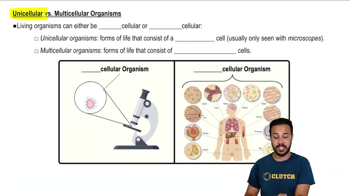
The cell is the fundamental structural and functional unit of all living organisms.
Life is organized from molecules to cells, tissues, organs, organ systems, organisms, populations, communities, ecosystems, and the biosphere.
Domains Bacteria, Archaea, and Eukarya.
Bacteria and Archaea contain prokaryotic organisms with simple cells.
Protists, Fungi, Plantae, and Animalia.
Taxonomy is the science of naming and classifying species into broader groups based on shared characteristics.
An emergent property arises from the specific arrangement and interactions of parts at each level of biological organization.
A process involving observation, hypothesis formation, prediction, experimentation, and data analysis to understand natural phenomena.
A testable explanation for a set of observations that can be supported or refuted through experimentation.
The independent variable is manipulated; the dependent variable is measured and depends on the independent variable.
An experiment comparing an experimental group with a control group to test the effect of a single variable.
Evolution is the process of change over generations that has transformed life on Earth, explaining unity and diversity.
A mechanism of evolution where individuals with heritable traits best suited to their environment have greater reproductive success.
DNA carries hereditary information and programs cellular activities by encoding proteins.
Biological structures are shaped to perform specific functions, from molecules to organisms.
Energy enters as sunlight, is converted by producers, passed to consumers, and exits as heat.
Matter cycles from the environment through producers, consumers, decomposers, and back to the environment.
A scientific approach that models the behavior of biological systems by analyzing interactions among their parts.