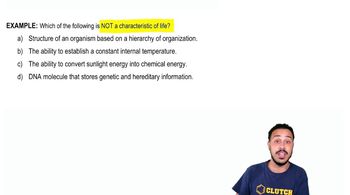
Characteristics of life not exhibited by a smartphone
Reproduction, response to environment, and homeostasis are not exhibited by a smartphone.
Characteristic of life fulfilled by a motor vehicle
A motor vehicle utilizes energy, fulfilling one characteristic of life.
Highest level of taxonomic organization
Domain is the highest level of taxonomic organization.
Four kingdoms of domain Eukarya and their characteristics
Plantae: producers using sunlight; Animalia: consumers needing food; Fungi: decomposers of dead matter; Protista: diverse mostly unicellular organisms.
Common feature of Archaea and Bacteria domains
All organisms in Archaea and Bacteria are prokaryotic.
Definition of a population in biology
A population is a group of organisms of the same species living in a specific area, e.g., a school of fish in a lake.
Emergent properties in biology
New characteristics that arise at higher levels of biological organization are called emergent properties.
Science as an approach
Science is an approach to understanding the natural world and its phenomena.
Difference between qualitative and quantitative data
Qualitative data are descriptive; quantitative data are numerical measurements.
Definition of a hypothesis
A hypothesis is a tentative explanation for observations, subject to testing.
Difference between hypothesis and theory
A theory is supported by extensive evidence; a hypothesis is a preliminary, testable idea.
Effect of camouflage on predation attacks
Noncamouflaged models experience more attacks than camouflaged ones, indicating camouflage reduces predation.
Number of variables differing between experimental and control groups
Only one variable should differ to isolate its effect.
Importance of controlling variables in experiments
Controlling variables ensures that observed effects are due to the tested factor alone.
Role of scientific community feedback
Feedback from peers is essential for forming and testing hypotheses and validating results.
Difference between science and technology
Science gains knowledge; technology applies that knowledge for practical purposes.
Definition of evolution
Evolution is the change in life forms on Earth over time.
Key observations in Darwin's theory of natural selection
Variation among individuals and overproduction of offspring lead to unequal reproductive success and adaptation.
Meaning of 'nature' in natural selection
'Nature' refers to the environment selecting for traits that increase survival and reproduction.
Common ancestry of red pandas, weasels, and raccoons
They share a common ancestor according to evolutionary trees.
Example of natural selection in pesticide resistance
Insects developing resistance to pesticides over time is an example of natural selection.
Genes as units of inheritance
Genes carry hereditary information passed from parents to offspring.
Genetic code analogy
DNA sequences are like letters arranged to form words, creating proteins with specific functions.
Universal genetic language
DNA is universal, allowing genes from one organism to function in another, e.g., human HGH in bacteria.
Five unifying themes of biology
Evolution, information, structure and function, energy and matter, and interactions.
Example of form following function at cellular level
Nerve cells have long extensions to transmit electrical signals over long distances.
Movement of energy and chemicals in ecosystems
Energy flows in one direction; nutrients are recycled within ecosystems.
Roles of producers, consumers, and decomposers
Producers make food; consumers eat producers or others; decomposers recycle nutrients from dead matter.
Definition of systems biology
Systems biology studies interactions among parts of biological systems to understand function.
 Back
Back
 09:26
09:26