 Back
BackGeneral Biology: Chemical Basis of Life
 02:13
02:13
Terms in this set (21)
Oxygen, Carbon, Hydrogen, and Nitrogen make up about 96% of the weight of most living organisms.
A compound is a substance consisting of two or more different elements in a fixed ratio.
Trace elements are required in small amounts to prevent disease and support health, such as fluoride added to water to reduce tooth decay.
Protons and neutrons are in the nucleus; electrons orbit the nucleus.
The number of protons in the nucleus determines an element's atomic number.
An isotope has the same number of protons but different numbers of neutrons.
Mass number is the sum of protons and neutrons; atomic mass is approximately equal to the mass number.
They serve as tracers to monitor atoms in organisms and can be detected by imaging instruments.
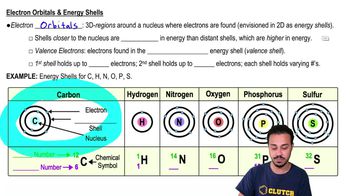
The distribution of electrons in electron shells determines chemical properties.
An ionic bond is an attraction between ions of opposite charge formed by the transfer of electrons.
A covalent bond involves sharing electrons between atoms.
Nonpolar covalent bonds share electrons equally; polar covalent bonds share electrons unequally due to electronegativity differences.
A hydrogen bond is a weak attraction between a hydrogen atom in one molecule and an electronegative atom in another.
Water has polar covalent bonds and a bent shape, causing an unequal distribution of charges.
Cohesion is water molecules sticking to each other; adhesion is water sticking to other substances.
Water absorbs and releases heat slowly due to hydrogen bonding, stabilizing temperature.
Ice is less dense because hydrogen bonds form a stable lattice that spaces molecules farther apart.
Its polarity allows it to surround and dissolve polar and charged solutes, forming aqueous solutions.
The pH scale measures acidity or basicity of a solution based on hydrogen ion concentration.
A buffer minimizes changes in pH by accepting or donating hydrogen ions.
CO2 dissolves in seawater, lowering pH and reducing carbonate ions needed for coral calcification.