 Back
BackGeneral Biology: Chemical Context of Life
 02:13
02:13
Terms in this set (19)
Matter is anything that takes up space and has mass.
An element is a substance that cannot be broken down by chemical reactions. A compound consists of two or more elements in a fixed ratio with different properties from its elements.
Carbon, hydrogen, oxygen, and nitrogen make up 96% of living matter.
An atom is the smallest unit of matter that retains the properties of an element.
Protons (positive), neutrons (no charge), and electrons (negative).
Atomic number is the number of protons; atomic mass is the sum of protons and neutrons.
Isotopes are atoms of the same element with different numbers of neutrons.
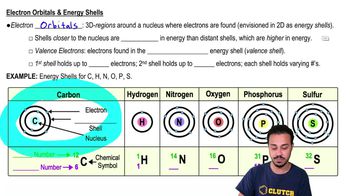
Potential energy is energy matter possesses due to its location or structure, such as electrons farther from the nucleus having higher potential energy.
The distribution of electrons in its electron shells, especially the number of valence electrons, determines chemical behavior.
A covalent bond is the sharing of a pair of valence electrons between two atoms.
A single bond shares one pair of electrons; a double bond shares two pairs.
Electronegativity is an atom's attraction for electrons in a covalent bond.
Nonpolar covalent bonds share electrons equally; polar covalent bonds share electrons unequally, causing partial charges.
An ionic bond is the attraction between oppositely charged ions formed when electrons are transferred.
Cation is a positively charged ion; anion is a negatively charged ion.
They help maintain the functional form of large biological molecules and allow reversible interactions.
A hydrogen bond is a weak attraction between a partially positive hydrogen atom and a partially negative atom in another molecule.
Chemical reactions involve the making and breaking of chemical bonds, converting reactants into products.
It is reached when the forward and reverse reactions occur at the same rate, and concentrations of reactants and products remain constant.