 Back
BackGeneral Biology: Chemical Context of Life
 02:13
02:13
Terms in this set (20)
Matter is anything that takes up space and has mass.
An element is a substance that cannot be broken down to other substances by chemical reactions.
A compound is a substance consisting of two or more elements in a fixed ratio with different characteristics from its elements.
An atom is the smallest unit of matter that retains the properties of an element.
Protons (positive), neutrons (no charge), and electrons (negative).
Protons and neutrons form the atomic nucleus at the center of the atom.
The atomic number is the number of protons in the nucleus of an atom.
Atomic mass is approximated by the mass number, the sum of protons and neutrons in the nucleus.
Isotopes are atoms of the same element with different numbers of neutrons.
Electronegativity is an atom's attraction for electrons in a covalent bond.
A covalent bond is the sharing of a pair of valence electrons between two atoms.
In nonpolar covalent bonds, electrons are shared equally; in polar covalent bonds, electrons are shared unequally due to differing electronegativities.
An ionic bond is an attraction between oppositely charged ions formed by electron transfer.
A cation is a positively charged ion; an anion is a negatively charged ion.
Salts are ionic compounds formed by ionic bonds, often found as crystals like sodium chloride.
A hydrogen bond forms when a hydrogen atom covalently bonded to one electronegative atom is attracted to another electronegative atom.
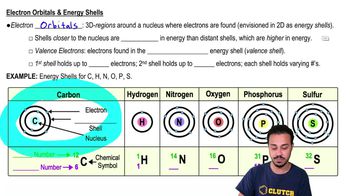
The distribution of valence electrons in the outermost shell determines an atom's chemical behavior.
Elements with full valence shells are chemically inert because they do not tend to share or transfer electrons.
A molecule consists of two or more atoms held together by covalent bonds.
A structural formula shows the arrangement of atoms and bonds; a molecular formula shows only the number of atoms of each element.