Back

General Biology: Digestive System and Nutrition

Control buttons has been changed to "navigation" mode.
1/29
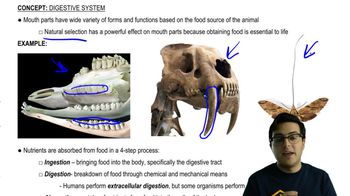
  • Define herbivores, carnivores, omnivores, suspension feeders, substrate feeders, fluid feeders, and bulk feeders.

    • Herbivores: eat plants.
    • Carnivores: eat other animals.
    • Omnivores: eat both plants and animals.
    • Suspension feeders: filter food particles from water.
    • Substrate feeders: live in or on their food source.
    • Fluid feeders: suck nutrient-rich fluids.
    • Bulk feeders: eat large pieces of food.
  • What are the four stages of food processing?

    1. Ingestion: taking in food.
    2. Digestion: breaking down food mechanically and chemically.
    3. Absorption: nutrients absorbed into the body.
    4. Elimination: removal of undigested waste.
  • What is ingestion and what are the four feeding mechanisms?

    Ingestion is the act of eating. The four feeding mechanisms are suspension feeding, substrate feeding, fluid feeding, and bulk feeding.
  • What is the difference between mechanical and chemical digestion?

    Mechanical digestion physically breaks food into smaller pieces. Chemical digestion breaks down food molecules using enzymes.
  • Compare gastrovascular cavity and alimentary canal.

    Gastrovascular cavity has a single opening for ingestion and elimination. Alimentary canal is a complete digestive tract with two openings, allowing one-way food flow.
  • Describe the specialized digestive systems of an earthworm, grasshopper, and bird.

    Earthworm: simple tube with crop and gizzard.
    Grasshopper: foregut, midgut, hindgut with specialized regions.
    Bird: crop for storage, gizzard for grinding.
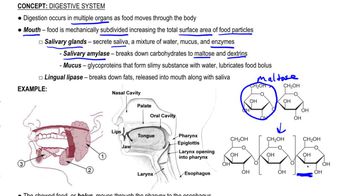
  • What are the main components of the human alimentary canal and associated glands?

    Includes mouth, pharynx, esophagus, stomach, small intestine, large intestine, rectum, anus, plus salivary glands, pancreas, liver, and gallbladder.
  • What are the functions of saliva and types of human teeth?

    Saliva moistens food, contains enzymes like amylase for starch digestion.
    Teeth types: incisors (cut), canines (tear), premolars and molars (grind).
  • How does swallowing occur and how is food directed away from the trachea?

    Swallowing moves food from mouth to esophagus. The epiglottis closes over the trachea to prevent food entry.
  • What is the pharynx and where do the esophagus and trachea lead?

    Pharynx: throat region connecting mouth to esophagus and trachea.
    Esophagus: leads to stomach.
    Trachea: leads to lungs.
  • Explain the Heimlich maneuver.

    A first aid procedure that uses abdominal thrusts to expel an object blocking the airway.
  • Relate stomach structure to its functions.

    The stomach has muscular walls for peristalsis and secretes gastric juice containing acid and enzymes for digestion.
  • What is peristalsis?

    Rhythmic muscle contractions that move food through the digestive tract.
  • What is gastric juice made of? Define pepsin and pepsinogen.

    Gastric juice contains hydrochloric acid and enzymes.
    Pepsinogen is inactive; converted to pepsin which digests proteins.
  • Why is the stomach lined with mucus?

    Mucus protects the stomach lining from being digested by acid and enzymes.
  • Describe chemical digestion in the small intestine.

    Enzymes from pancreas and intestinal lining break down proteins, fats, and carbohydrates.
  • What does the pancreas produce to neutralize stomach acid?

    The pancreas produces bicarbonate ions to neutralize acidic chyme entering the small intestine.
  • What does the liver produce and what is its role in digestion?

    The liver produces bile, stored in the gallbladder, which aids in fat digestion.
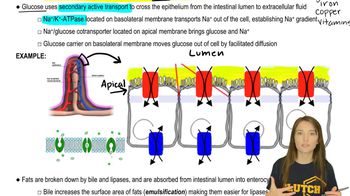
  • What structures increase surface area in the intestines?

    Villi and microvilli increase the surface area for nutrient absorption.
  • How does the liver regulate blood chemical composition?

    The liver processes nutrients, detoxifies chemicals, and regulates blood glucose and lipid levels.
  • Which vein carries nutrient-rich blood from the intestines to the liver?

    The hepatic portal vein carries nutrient-rich blood from intestinal capillaries to the liver.
  • Describe the functions of the colon and rectum.

    The colon absorbs water and salts; the rectum stores feces before elimination.
  • What is the function of the caecum?

    The caecum aids in the digestion of plant material, especially in herbivores.
  • Why do herbivores have longer intestinal tracts than carnivores?

    Longer tracts allow more time to break down and absorb nutrients from plant cellulose.
  • What digestive adaptations do cows have?

    Cows have a multi-chambered stomach to ferment and digest cellulose efficiently.
  • List the three nutritional needs common to all animals.

    Energy source, organic molecules for biosynthesis, and essential nutrients.
  • Define basal metabolic rate (BMR).

    BMR is the energy used by an organism at rest to maintain basic physiological functions.
  • Describe the four classes of essential nutrients.

    • Essential amino acids
    • Essential fatty acids
    • Vitamins
    • Minerals
  • What are vitamins and minerals?

    Vitamins are organic compounds required in small amounts.
    Minerals are inorganic elements essential for body functions.