 Back
BackGeneral Biology: DNA, Genetics & Evolution
 05:10
05:10
Terms in this set (30)
DNA (deoxyribonucleic acid) is the molecule of inheritance that carries genetic information for the development and functioning of living organisms.
DNA is located in the nucleus and mitochondria of a cell.
DNA codes for proteins that determine inherited characteristics in organisms.
Nucleotides are the building blocks of DNA, each consisting of a sugar, phosphate, and nitrogenous base; they form the DNA double helix by pairing complementary bases.
The four bases are adenine (A), thymine (T), cytosine (C), and guanine (G). A pairs with T, and C pairs with G.
DNA is the molecule, genes are segments of DNA coding for traits, and chromosomes are structures made of DNA and proteins that carry genes.
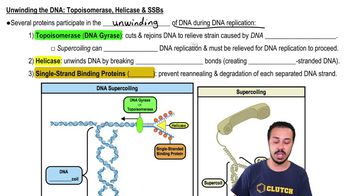
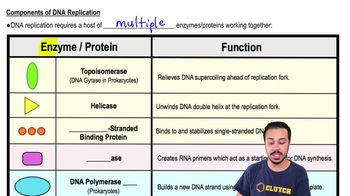
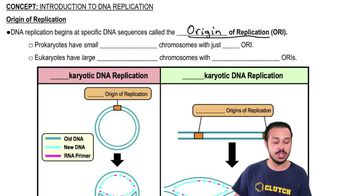
DNA replication involves unwinding the double helix by helicase, synthesizing new strands by DNA polymerase, and joining fragments with ligase.
DNA is double-stranded with thymine, stores genetic info; RNA is single-stranded with uracil, involved in protein synthesis.
Mitosis is the division of somatic cells for growth and repair, producing two identical diploid daughter cells.
Stages: Prophase (chromosomes condense), Metaphase (chromosomes align), Anaphase (chromatids separate), Telophase (nuclei reform), Cytokinesis (cell divides).
Gametes are sex cells; male gametes (sperm) are produced in testes, female gametes (eggs/ova) in ovaries.
Fertilisation is the fusion of male and female gametes, resulting in a zygote with a full set of chromosomes.
Homologous pairs are chromosome pairs with the same genes; diploid (2n) cells have two sets of chromosomes; haploid (n) cells have one set.
Meiosis reduces chromosome number by half and creates genetic variation through two divisions producing haploid gametes.
Mitosis produces two identical diploid cells for growth; meiosis produces four genetically varied haploid cells for reproduction.
Mutations are sudden, permanent changes in genes that can create new alleles and contribute to genetic variation.
Mutagens include physical (e.g., UV radiation), chemical (e.g., tobacco smoke), and biological (e.g., viruses).
Allele: gene variant; genotype: genetic makeup; phenotype: observable traits; dominant: expressed allele; recessive: masked allele; homozygous: identical alleles; heterozygous: different alleles.
Punnett squares predict possible genotypes and phenotypes from monohybrid crosses, including complete dominance, co-dominance, and incomplete dominance.
Sex is determined by X and Y chromosomes; males are XY, females XX; inheritance patterns can be shown using Punnett squares.
A pedigree is a diagram showing family relationships and inheritance of traits, used to determine genotypes and phenotypes.
Lamarck proposed acquired characteristics are inherited; Darwin proposed natural selection based on variation and survival of the fittest.
Artificial selection is selective breeding by humans to enhance desired traits in plants and animals.
Natural selection involves variation, competition, survival, and reproduction of the fittest individuals in a population.
Mutations create genetic variation, providing new traits that may increase survival and reproduction in natural selection.
Speciation is the formation of new species through isolation, variation, and selection over time.
A gene pool is the total genetic diversity in a population; gene flow is the transfer of genes between populations.
Fossils form under specific conditions; their age is determined by relative dating (rock layers) and absolute dating (radiometric methods).
Evidence includes comparative anatomy (homologous/analogous structures), vestigial organs, embryology, and DNA/protein comparisons.
Continental drift explains biogeographical distribution of species, supporting common ancestry and evolution.