 Back
BackGeneral Biology: Ecology and Thermoregulation
 06:28
06:28
Terms in this set (30)
The ability of an organism to keep its body temperature within a range compatible with life.
Enzymes work at optimum temperature; proteins denature and membranes become fragile at high temperatures; body fluids become viscous at low temperatures.
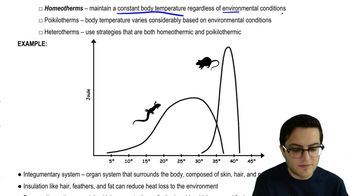
Organisms that allow their internal conditions to change with external conditions; passive adjustment of body temperature.
Organisms that use internal mechanisms and negative feedback loops to maintain constant internal conditions despite environmental changes.
Organisms that generate heat via high metabolism; includes birds and mammals; require high energy but maintain constant activity.
Organisms that absorb heat from the environment; includes fish, amphibians, reptiles; energy-efficient but activity depends on ambient temperature.
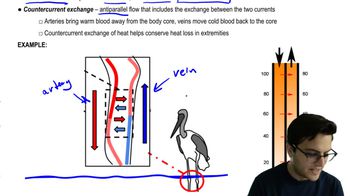
Widening of superficial blood vessels to increase heat loss from the body.
Narrowing of superficial blood vessels to reduce heat loss from the body.
The hypothalamus regulates body temperature by triggering heat loss or heat-generating mechanisms; fever changes the set point.
Physiological adjustment to environmental changes allowing organisms to modify insulation or metabolic rate.
The study of interactions between organisms and their environment at various hierarchical levels.
Study of interactions among individuals of the same species, including population size and influencing factors.
Study of interactions among populations of different species within an area and community structure.
Study of communities and their physical environment, focusing on energy flow and chemical cycling.
Tropical regions have higher species abundance and diversity due to evolutionary history and climate stability.
Major life zones characterized by vegetation type and climate, including tropical forests, deserts, savannas, and tundra.
Number of individuals per unit area or volume within a population's boundaries.
Clumped, uniform, and random spacing of individuals influenced by environmental and social factors.
Graphical representation of survival patterns: Type I (low early death), Type II (constant death), Type III (high early death).
Population increase under ideal conditions with maximum rate of increase.
The maximum population size an environment can support based on resource availability.
Population growth model where growth rate decreases as population size approaches carrying capacity.
Selective pressures balance offspring number and size, trading quantity for quality or vice versa.
K-selection favors traits sensitive to population density with stable populations; r-selection favors high reproduction regardless of density with boom-bust cycles.
Population regulation by factors like competition, predation, disease, and territoriality that intensify with population density.
An organism's ecological role including resource use, environmental response, and influence on other species.
Two species competing for the same resource cannot coexist; one outcompetes the other.
A symbiotic relationship where both species benefit.
Feeding relationships in a community, including food chains and food webs showing energy and nutrient transfer.
Species with a strong ecological role that greatly influences community structure despite low abundance.