 Back
BackGeneral Biology: Ecology Final Study Guide

 05:01
05:01
Terms in this set (26)
Ecology is the study of interactions between organisms and their environment.
Pattern refers to the spatial or temporal distribution of organisms; Process refers to the mechanisms that create these patterns.
Climate is the long-term average of weather conditions; Weather is the short-term atmospheric conditions.
A Hadley cell is a large-scale atmospheric convection cell that influences tropical climate and rainfall patterns.
The greenhouse effect is the warming of Earth’s surface due to atmospheric gases trapping heat.
Adaptation is a heritable trait that increases an organism’s fitness in its environment.
Acclimatization is a reversible physiological adjustment to environmental changes.
Ectotherms rely on external heat sources; endotherms generate internal heat to regulate body temperature.
Phenotypic plasticity is the ability of one genotype to produce different phenotypes in response to environmental conditions.
Life history traits are characteristics related to growth, reproduction, and survival that influence fitness.
Selective mortality occurs when certain phenotypes have higher survival rates; it can be measured by comparing trait frequencies before and after selection.
Intra-sexual selection is competition within a sex; inter-sexual selection is mate choice by the opposite sex.
r-selected species produce many offspring with low survival; K-selected species produce fewer offspring with higher investment.
Three types: clumped, uniform, and random, influenced by resource availability and social behavior.
Density-independent factors affect populations regardless of size; density-dependent factors vary with population density.
Carrying capacity is the maximum population size an environment can sustain indefinitely.
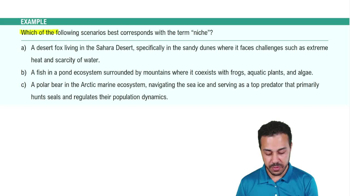
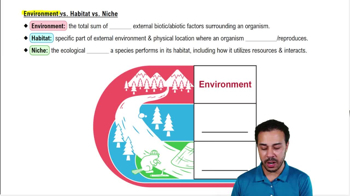
Fundamental niche is the full range of conditions a species can tolerate; realized niche is where it actually exists due to biotic interactions.
Symbiosis is a close interaction between species, including mutualism, commensalism, and parasitism.
A keystone species has a disproportionately large effect on community structure relative to its abundance.
Primary succession occurs on newly formed habitats without soil; secondary succession occurs where a community was disturbed but soil remains.
GPP is total energy captured by photosynthesis; NPP is energy remaining after plant respiration.
Predicts that organisms maximize energy gained per unit time by selecting prey with highest profitability.
Assumes predator and prey populations interact with no environmental complexity, constant rates, and no time lags.
A measure of species diversity that accounts for both richness and evenness in a community.
Benefits humans receive from ecosystems, including provisioning, regulating, cultural, and supporting services.
EBM integrates ecological, social, and economic goals to manage ecosystems sustainably, unlike single-sector management.