 Back
General Biology: Energy, Enzymes, and Metabolism
 04:21

Terms in this set (31)
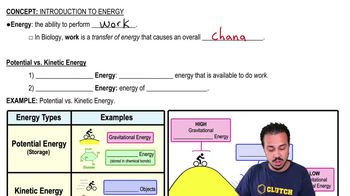
Kinetic energy is the energy of motion.
Potential energy is energy stored in position or configuration, such as chemical bonds.
Chemical energy is energy stored in chemical bonds, which can be released during reactions.
Longer, weaker bonds with equally shared electrons have high potential energy. Shorter, stronger bonds with unequal sharing have low potential energy.
Carbohydrates have many single bonds with high potential energy, making them good for storing energy.
Lipids have more nonpolar C-H bonds and greater stability, so breaking them releases more energy than carbohydrates.
Energy is conserved; it can be transferred or transformed but not created or destroyed.
Enthalpy is the total energy in a molecule, including potential energy in bonds and kinetic energy effects from pressure and volume.
Exothermic reactions release heat and have negative change in enthalpy (-H). Endothermic reactions absorb heat and have positive change in enthalpy (+H).
Entropy is the amount of disorder in a system; it tends to increase in spontaneous processes (+S).
Total entropy of the universe always increases; spontaneous processes increase disorder.
Gibbs free energy is given by \(G=H-TS\), where G is free energy, H is enthalpy, T is temperature in Kelvin, and S is entropy.
G < 0: reaction is exergonic and spontaneous.
G > 0: reaction is endergonic and nonspontaneous.
G = 0: reaction is at equilibrium.
Higher temperature, higher concentration, and proper molecular orientation increase reaction rates by increasing collision frequency and energy.
Exergonic reactions release energy that can drive endergonic reactions through coupling, often via transfer of electrons or phosphate groups.
Oxidation is loss of electrons (exergonic). Reduction is gain of electrons (endergonic).
NAD+ and FAD are electron carriers that accept electrons and protons to form NADH and FADH2, storing reducing power.
ATP has high potential energy due to repulsion between negatively charged phosphate groups and energy stored in their bonds.
ATP reacts with water to break the bond between its outermost phosphate groups, releasing free energy and forming ADP.
Phosphorylation adds a phosphate group to a molecule, increasing its potential energy and enabling energy coupling.
Activation energy is the energy required to start a reaction by breaking bonds and reaching the transition state.
Enzymes stabilize the transition state, orient substrates precisely, and reduce entropy to lower activation energy.
Substrate binding causes a conformational change in the enzyme, improving substrate binding and catalysis.
At high substrate concentrations, enzyme active sites are fully occupied, and reaction rate plateaus.
Cofactors are inorganic ions; coenzymes are organic molecules; prosthetic groups are permanently attached non-amino acid molecules aiding enzyme function.
Temperature, pH, and interactions with other molecules affect enzyme shape and activity.
A molecule competes with the substrate for the enzyme's active site, reducing enzyme activity.
A molecule binds to a site other than the active site, causing a conformational change that activates or inhibits the enzyme.
Reversible changes like phosphorylation alter enzyme shape and activity; irreversible changes involve peptide bond cleavage.
The final product of a metabolic pathway inhibits an earlier enzyme to regulate the pathway and prevent excess product formation.
Catabolic pathways break down molecules to release energy.
Anabolic pathways use energy to build molecules.