 Back
BackGeneral Biology - Evolution and Adaptation
 07:48
07:48
Terms in this set (26)
Evolution is the change in allele frequency over time, also described as descent with modification.
Trophy hunting removes individuals with the largest horns, leading to a decrease in average horn size and weight over time due to selective survival of smaller-horned sheep.
Horns determine winners in competitive interactions for mates, and horn size is a heritable trait passed to offspring.
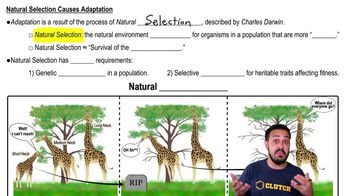
Natural selection is the process where individuals with certain heritable traits survive and reproduce more successfully than others.
There must be heritable variation in traits that affect survival or reproduction, leading to differential survival or fecundity.
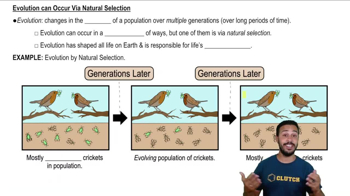
Crows prefer green beetles, so green beetles are eaten more, causing brown beetles to increase in frequency over time.
Variation exists in populations, traits are heritable, and traits affect survival or reproduction, leading to unequal contributions to future generations.
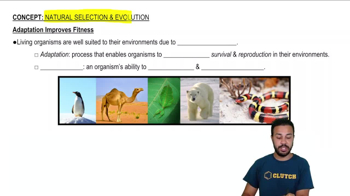
An adaptation is a genetically determined trait that enhances survival and reproduction of its bearers.
Physiological (e.g., enzymes), morphological (e.g., frog's long legs), and behavioral (e.g., innate nursing behavior).
Deep sea vent bacteria using hydrogen sulfide as an energy source to survive in hydrothermal vents.
Directional selection shifts the average value of a trait in one direction over time, such as larger beak size in finches after a drought.
Stabilizing selection favors intermediate phenotypes and selects against extremes, maintaining average trait values.
Eurosta flies' gall size is stabilized because wasps prefer small galls and birds prefer large galls, favoring intermediate sizes.
Disruptive selection favors individuals with extreme trait values and selects against intermediates.
Birds with small bills eat soft seeds, large bills eat hard seeds, and intermediate bill sizes are selected against.
Evolution is the change in heritable traits across a population over generations, not changes within a single individual.
Gene flow can reduce local adaptation, evolution requires existing genetic variation, and evolutionary history constrains possible traits.
Carrying one sickle-cell allele confers malaria resistance but can cause sickle-cell disease symptoms, showing a tradeoff between benefits and costs.
Ecological interactions can drive evolutionary changes, and evolution can alter ecological relationships, such as predator-prey adaptations.
Evolution does not produce perfectly adapted organisms because environments constantly change in space and time.
Darwin was an English naturalist who established evolution by natural selection as the dominant explanation for species diversification.
Heritability means that variation in a trait is genetic and can be passed from parents to offspring, enabling natural selection.
The drought reduced seed abundance, favoring finches with larger beaks that could crack hard seeds, shifting average beak size.
Dark-colored moths were selected against due to pollution increasing lichen growth, favoring lighter grey moths for camouflage.
Innate behaviors are genetically inherited and passed on, while learned behaviors are acquired and not inherited.
Because evolutionary traits arise from existing traits, and horses lack wings while birds lack four legs, so such a combination is not possible.