 Back
BackGeneral Biology: Evolution and Classification
 07:48
07:48
Terms in this set (32)
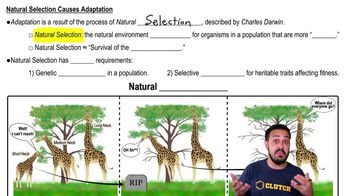
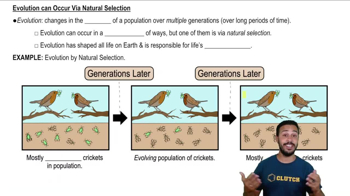
Natural selection is the primary mechanism driving evolution according to modern evolutionary synthesis.
A two-part naming system for species using genus and species names, e.g., Homo sapiens.
Carolus Linnaeus is considered the father of taxonomy.
Introduced by Carolus Linnaeus, organizing species into hierarchical groups based on shared characteristics.
Paleontology, the study of fossils and extinct organisms.
Called strata, these layers preserve fossils and provide a timeline of life.
Naturalist on the HMS Beagle, collecting species globally.
Proposed by Charles Lyell, stating Earth's features are shaped by slow, continuous processes over long periods.
He proposed that organisms pass on traits acquired during their lifetime, which is incorrect.
Descent with modification, meaning species change over time from common ancestors.
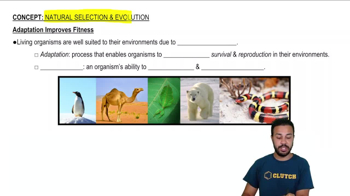
Adaptations are inherited traits that improve survival and reproduction in specific environments.
Alfred Russel Wallace independently developed the theory of natural selection.
Humans modify species by selecting and breeding individuals with desired traits.
1) Variation exists in populations.
2) More offspring are produced than can survive.
Population level, as allele frequencies change over generations.
No, it selects for existing variation but does not create new traits.
Includes direct observation, fossil record, homology, and biogeography.
Structures with no current function but inherited from ancestors, supporting evolution.
Homologous share ancestry; analogous have similar function but different ancestry.
A model where allele frequencies remain constant if five conditions are met: no mutation, random mating, no gene flow, infinite population size, and no selection.
Bottleneck effect: drastic population reduction.
Founder effect: small group isolated.
Directional, disruptive, and stabilizing selection.
Intrasexual: competition within a sex.
Intersexual: mate choice by one sex.
Defines species as groups that can interbreed and produce viable, fertile offspring.
Barriers preventing fertilization, e.g., temporal, habitat, behavioral, mechanical, and gametic isolation.
Barriers after fertilization, including reduced hybrid viability, fertility, and hybrid breakdown.
Speciation due to geographic isolation of populations.
Having multiple sets of chromosomes, common in plants, leading to speciation.
Diagram showing evolutionary relationships among species based on common ancestry.
Homologous traits indicate shared ancestry; analogous traits arise from convergent evolution.
A group including an ancestor and all its descendants (monophyletic group).
Choosing the phylogenetic tree that requires the fewest evolutionary changes.