 Back
BackGeneral Biology: Evolution and Development Concepts
 07:48
07:48

Terms in this set (27)
Bicoid is a morphogen gradient; its concentration determines cell fate during early development.
Hox genes control the body plan and contain a conserved DNA-binding domain called the homeobox.
Toolkit genes are the same genes with different regulation, leading to different body plans across species.
Lamarck proposed that acquired traits are passed on to offspring, which is incorrect.
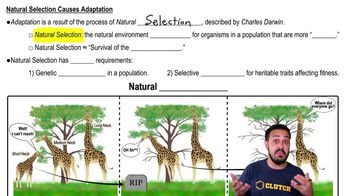
Darwin emphasized heritable variation and differential survival and reproduction as drivers of evolution.
- Variation exists in populations
- Variation is heritable
- More offspring produced than survive
- Survival/reproduction is non-random and tied to heritable traits
No mutation, no selection, random mating, no genetic drift, and no gene flow.
Violation of any of the 5 conditions means evolution is occurring in the population.
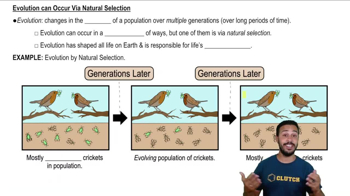
- Natural selection
- Genetic drift
- Mutation
- Gene flow
Stabilizing selection reduces variation and favors intermediate phenotypes.
Directional selection shifts the population mean toward one extreme phenotype.
Disruptive selection favors both extremes and can split a population into two groups.
Balancing selection maintains multiple alleles in a population, such as through heterozygote advantage.
A bottleneck is a population crash where survivors are random, reducing genetic diversity.
The founder effect occurs when a small group colonizes a new area, reducing genetic diversity and fixing alleles randomly.
Homology is shared ancestry; homoplasy is similarity due to convergent or analogous traits.
A synapomorphy is a derived trait shared by a clade, indicating common ancestry.
Parsimony favors the evolutionary tree with the fewest changes.
- Biological: reproductive isolation
- Morphological: form differences
- Phylogenetic: shared derived traits
Allopatric speciation occurs when geographic barriers cause populations to diverge.
Sympatric speciation occurs without geographic barriers; polyploidy is a common mechanism in plants.
Reinforcement is selection that strengthens prezygotic isolation in hybrid zones.
Fossil record biases include preservation of hard parts and over-representation of certain environments.
The molecular clock uses mutation rates to estimate divergence times between species.
Adaptive radiation is rapid diversification of a single lineage into many ecological niches.
The Cambrian explosion (~539 million years ago) was a rapid appearance of most animal body plans.
The Phanerozoic is the last 539 million years of geologic time, divided into Paleozoic, Mesozoic, and Cenozoic eras.