 Back
BackGeneral Biology: Evolution and Natural Selection
 07:48
07:48
Terms in this set (22)
Charles Darwin was a well-educated English naturalist who traveled on the HMS Beagle and made detailed observations about living species, leading to his theory of evolution.
Darwin observed great diversity among living things worldwide, similar species in different places, variations within species, and fossils resembling modern organisms but with differences.
Malthus proposed that populations grow faster than their resources, causing competition and death, influencing Darwin's idea of survival struggle.
Uniformitarianism is the idea that Earth's surface changes gradually over long periods through small processes like erosion.
Lamarck suggested acquired traits could be passed to offspring, but traits must involve genetic changes in gametes to be inherited, which Lamarck's theory lacked.
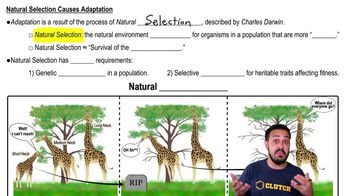
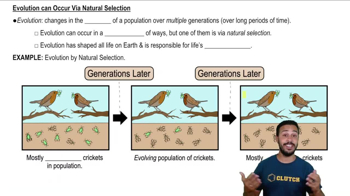
Natural selection is the process where individuals with traits best suited to their environment survive and reproduce more successfully, leading to evolution.
1. Individuals compete to survive.
2. Those with the best fitness survive more.
3. Organisms change over time through descent with modification.
Artificial selection is when humans breed plants or animals for desired traits, influencing evolution by selecting specific characteristics.
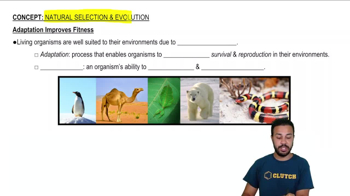
Fitness refers to how well an organism's traits suit its environment, increasing its chances of survival and reproduction.
Genetic variation arises from mutations, sexual reproduction (gene shuffling), and gene flow between populations.
A gene pool is the total set of all alleles present in a population.
Allele frequencies in a population remain constant (genetic equilibrium) unless factors like mutation, migration, or selection cause change.
No mutations, no immigration/emigration, no natural selection, random mating, and a large population size.
Natural selection can increase the frequency of one phenotype over another, reducing variation when one trait is more fit.
Natural selection can cause directional, stabilizing, or disruptive selection, shifting the distribution of phenotypes in a population.
Genetic drift is a random change in allele frequencies in a population, especially significant in small populations.
A genetic bottleneck occurs when a large portion of a population is killed, leaving a small, genetically different surviving group.
The founder effect happens when a few individuals start a new population with different allele frequencies than the original population.
Speciation is the formation of new species when populations become reproductively isolated and can no longer interbreed.
Geographic, behavioral, mechanical, and temporal isolation prevent populations from interbreeding, leading to speciation.
Prezygotic barriers prevent mating or fertilization; postzygotic barriers prevent viable or fertile offspring after fertilization.
A mule, a sterile hybrid offspring of a horse and donkey, is an example of a postzygotic barrier.