 Back
BackGeneral Biology: Evolution and Speciation Study Guide
 07:48
07:48
Terms in this set (30)
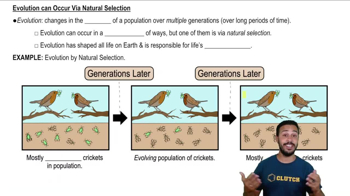
Evolution is the change in the genetic composition of a population over successive generations.
Descent with modification means that species change over time, giving rise to new species while sharing a common ancestor.
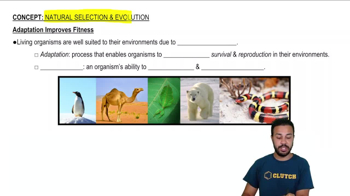
An adaptation is a heritable trait that increases an organism's fitness in its environment.
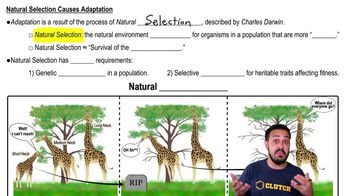
Natural selection is the process where individuals with advantageous traits are more likely to survive and reproduce.
Artificial selection is human-driven breeding to select for desired traits, differing from natural selection by intentional choice.
Homologous structures are anatomical features shared by species due to common ancestry, even if their functions differ.
Analogous structures have similar functions but evolved independently, not from a common ancestor.
Vestigial structures are remnants of features that served important functions in ancestors but are now reduced or nonfunctional.
Molecular homology refers to similarities in DNA or protein sequences that indicate common ancestry.
Convergent evolution occurs when unrelated species evolve similar traits due to similar environmental pressures.
The fossil record provides chronological evidence of past life forms and evolutionary changes over time.
Biogeography studies the geographic distribution of species, supporting evolution through patterns like continental drift.
Microevolution is the change in allele frequencies within a population over time.
Genetic drift is a random change in allele frequencies, especially significant in small populations.
Gene flow is the transfer of alleles between populations, which can reduce genetic differences.
Hardy-Weinberg equilibrium describes a non-evolving population where allele frequencies remain constant under five conditions.
Directional selection favors one extreme phenotype, shifting allele frequencies in one direction.
Disruptive selection favors two or more extreme phenotypes over intermediate ones.
Stabilizing selection favors intermediate phenotypes and reduces variation.
Sexual selection is natural selection for mating success, including intrasexual and intersexual selection.
Speciation is the process by which one species splits into two or more distinct species.
The biological species concept defines species as groups of interbreeding populations that produce viable, fertile offspring.
Reproductive isolation prevents gene flow between populations through prezygotic or postzygotic barriers.
Prezygotic barriers prevent mating or fertilization and include habitat, temporal, behavioral, mechanical, and gametic isolation.
Postzygotic barriers reduce hybrid viability or fertility, or cause hybrid breakdown after fertilization.
Allopatric speciation occurs when geographic isolation leads to reproductive isolation and divergence.
Sympatric speciation occurs without geographic isolation, often through polyploidy or sexual selection.
Polyploidy is the presence of extra sets of chromosomes, which can cause instant reproductive isolation.
A hybrid zone is a region where members of different species meet and mate, producing hybrids.
Punctuated equilibrium describes rapid speciation events followed by long periods of little change.