 Back
BackGeneral Biology: Evolution of Populations
 03:33
03:33
Terms in this set (23)
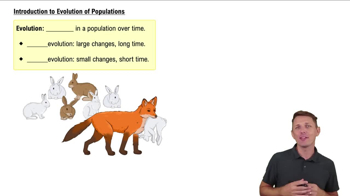
Populations evolve over generations, not individuals. Natural selection acts on individuals, but evolutionary change is seen in populations.
Microevolution refers to changes in allele frequencies within a population over generations.
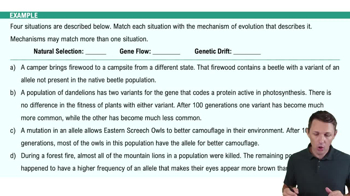
Natural selection, genetic drift, and gene flow.
Natural selection is the only mechanism that leads to adaptive evolution.
Genetic variation is caused by differences in genes or segments of DNA, combined with environmental influences.
Discrete characters have distinct categories, while quantitative characters vary along a continuum.
It measures the percentage of loci at which individuals are heterozygous in a population.
Differences in gene pools of separate populations due to geographic isolation or environmental gradients.
Mutations can introduce new alleles by changing nucleotide sequences; they can be neutral, harmful, or beneficial.
Because only mutations in gamete-producing cells can be inherited.
By recombining alleles during meiosis, sexual reproduction creates new genetic combinations.
Allele and genotype frequencies in a population remain constant between generations if no evolution occurs.
No mutations, random mating, no natural selection, large population size, and no gene flow.
Count alleles for each genotype, multiply homozygous individuals by 2, add heterozygous alleles, then divide by total alleles.
\((p+q)^2 = p^2 + 2pq + q^2\), where p and q are allele frequencies.
Random fluctuations in allele frequencies, especially significant in small populations.
When a small group separates from a larger population, causing different allele frequencies in the new group.
A drastic reduction in population size that changes allele frequencies due to chance survival.
Movement of alleles between populations through migration, which can increase or decrease genetic variation and fitness.
Directional (favors one extreme), disruptive (favors extremes), and stabilizing (favors intermediate phenotypes).
A form of natural selection that increases mating success, often causing sexual dimorphism.
When heterozygous individuals have higher fitness than either homozygote, maintaining genetic variation.
Because it can only act on existing variation, is limited by historical constraints, and environments constantly change.