Skip to main content
General Biology
My Course
Learn
Exam Prep
AI Tutor
Study Guides
Textbook Solutions
Flashcards
Explore
Try the app
My Course
Learn
Exam Prep
AI Tutor
Study Guides
Textbook Solutions
Flashcards
Explore
Try the app
Back
General Biology Exam 1: Chapters 1-5
You can tap to flip the card.
What is the basic unit of life?
You can tap to flip the card.
👆
What is the basic unit of life?
The
cell
is the basic unit of life.
Track progress
Control buttons has been changed to "navigation" mode.
1/20
Recommended videos
02:09
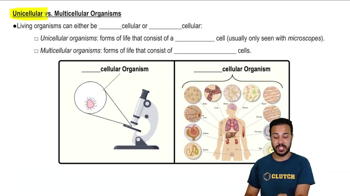
Unicellular vs. Multicellular
37852
views
1387
rank
2
comments
02:54
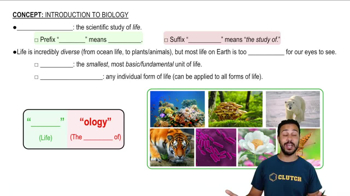
Introduction to Biology
60019
views
2207
rank
14
comments
1:28
Introduction to Biology Channel
71212
views
1807
rank
15
comments
Terms in this set (20)
Hide definitions
What is the basic unit of life?
The
cell
is the basic unit of life.
Define homeostasis.
Homeostasis
is the maintenance of a stable internal environment.
What are the four main types of biological macromolecules?
Carbohydrates, lipids, proteins,
and
nucleic acids
.
What is the function of enzymes?
Enzymes act as
biological catalysts
that speed up chemical reactions.
Describe the structure of a phospholipid.
A phospholipid has a
hydrophilic head
and two
hydrophobic fatty acid tails
.
What is the central dogma of molecular biology?
DNA is transcribed into RNA, which is translated into protein.
What is the role of mitochondria?
Mitochondria generate
ATP
through cellular respiration.
Define osmosis.
Osmosis is the diffusion of water across a selectively permeable membrane.
What is the difference between prokaryotic and eukaryotic cells?
Prokaryotes lack a nucleus and membrane-bound organelles; eukaryotes have both.
What is an ionic bond?
An ionic bond forms when electrons are transferred between atoms, creating charged ions.
What is the function of ribosomes?
Ribosomes synthesize proteins by translating mRNA.
What is the significance of the cell membrane?
The cell membrane controls the movement of substances in and out of the cell.
Define diffusion.
Diffusion is the movement of molecules from an area of higher concentration to lower concentration.
What is the role of DNA polymerase?
DNA polymerase synthesizes new DNA strands during replication.
What are the components of nucleotides?
A nucleotide consists of a
phosphate group
, a
sugar
, and a
nitrogenous base
.
What is the function of the Golgi apparatus?
The Golgi apparatus modifies, sorts, and packages proteins for secretion or use in the cell.
Explain the fluid mosaic model.
The cell membrane is a fluid structure with proteins embedded in or attached to a bilayer of phospholipids.
What is the difference between saturated and unsaturated fats?
Saturated fats have no double bonds; unsaturated fats have one or more double bonds in their fatty acid chains.
What is the function of chloroplasts?
Chloroplasts conduct photosynthesis to convert light energy into chemical energy.
Define ATP.
ATP (adenosine triphosphate) is the primary energy carrier in cells.
 BackBack
 02:09