 Back
BackGeneral Biology Exam 1 Key Concepts
 01:35
01:35
Terms in this set (31)
Science is empirical, testable, repeatable, and self-correcting. It relies on observation, experimentation, and evidence to understand natural phenomena.
Life is characterized by organization, metabolism, homeostasis, growth, reproduction, response to stimuli, and evolution.
An observation is a fact noticed; a hypothesis is a testable explanation; a theory is a well-supported broad explanation; a law describes a consistent natural phenomenon.
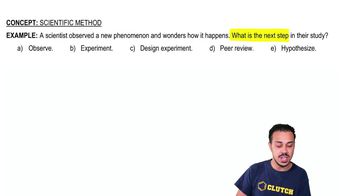
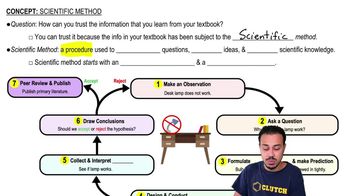
Includes observation, question, hypothesis, experiment, data collection, analysis, and conclusion.
Includes a hypothesis, experimental group, control group, independent variable, dependent variable, and standardized variables.
A hypothesis is a clear, testable statement predicting the relationship between variables based on observations.
Independent variable is manipulated; dependent variable is measured; standardized variables are kept constant.
Carbon (C), Hydrogen (H), Oxygen (O), Nitrogen (N), Phosphorus (P), and Sulfur (S) are the main elements.
Atoms consist of protons (+), neutrons (neutral) in the nucleus, and electrons (-) orbiting the nucleus.
An atom is a single element unit; a molecule is two or more atoms bonded together.
Includes ionic, covalent (polar and nonpolar), and hydrogen bonds.
Electronegativity differences cause electrons to be shared unequally in polar covalent bonds and equally in nonpolar covalent bonds.
Hydrogen bonds form between the slightly positive hydrogen of one water molecule and the slightly negative oxygen of another.
Water's polarity and hydrogen bonding give it high cohesion, adhesion, specific heat, and solvent abilities.
An emergent property arises when components interact to produce new functions not present in individual parts.
Process where monomers join to form polymers by removing water molecules.
Process of breaking down polymers into monomers by adding water.
Exergonic reactions release energy; endergonic reactions require energy input. Anabolic reactions build molecules (endergonic), catabolic break down molecules (exergonic).
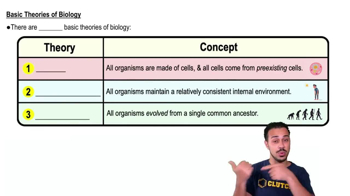
All living things are made of cells; cells are the basic unit of life; all cells come from pre-existing cells.
Plasma membrane, cytoplasm, ribosomes, and genetic material (DNA or RNA).
Bacteria and Archaea are prokaryotes without nuclei; Eukarya have nuclei and membrane-bound organelles.
Membranes are phospholipid bilayers with embedded proteins, allowing fluidity and selective permeability.
Phospholipids have hydrophilic heads and hydrophobic tails, forming bilayers in water.
Determined by lipid bilayer properties and membrane proteins; controls molecule passage based on size, charge, and polarity.
Simple diffusion, facilitated diffusion, and osmosis move substances down concentration gradients without energy.
Active transport uses energy to move substances against gradients; the Sodium-Potassium Pump exchanges Na+ and K+ ions across membranes.
Processes for moving large molecules or particles into (endocytosis) or out of (exocytosis) cells via vesicles.
Neurons have a cell body, dendrites (receive signals), and axons (transmit signals).
A gradient of ion concentration and electrical charge across a membrane that drives ion movement.
Resting potential is the stable, negative charge inside a neuron; action potential is a rapid, temporary change in membrane potential for signal transmission.
Chemicals released at synapses to transmit signals between neurons or to muscles.