 Back
BackGeneral Biology Exam 1 Study Guide Chapters 1-3
 02:09
02:09

Terms in this set (26)
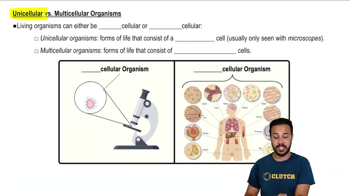
A cell without a nucleus or membrane-bound organelles, typically found in bacteria and archaea.
A cell with a nucleus and membrane-bound organelles, found in plants, animals, fungi, and protists.
The process by which organisms better adapted to their environment tend to survive and produce more offspring.
A systematic process for asking questions, making observations, forming hypotheses, conducting experiments, and drawing conclusions.
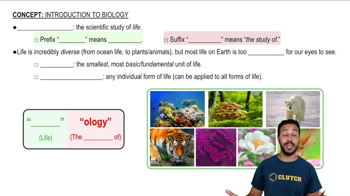
The cell is the basic unit of life.
DNA is the information molecule of life.
Carbohydrates, lipids, proteins, and nucleic acids.
Carbon, hydrogen, oxygen, nitrogen, phosphorus, and sulfur.
Atoms of the same element with different numbers of neutrons.
A chemical bond formed by the sharing of electron pairs between atoms.
A chemical bond formed by the transfer of electrons from one atom to another, creating ions.
A weak bond between a hydrogen atom and an electronegative atom like oxygen or nitrogen.
Water is a polar molecule with two hydrogen atoms covalently bonded to one oxygen atom.
Water is a solvent, helps regulate temperature, participates in chemical reactions, and supports life processes.
Specific groups of atoms within molecules that have characteristic properties and chemical reactivity.
A large molecule made up of repeating subunits called monomers.
A chemical reaction that joins monomers by removing a water molecule.
A chemical reaction that breaks bonds between monomers by adding a water molecule.
Macromolecules made of carbon, hydrogen, and oxygen that serve as energy sources and structural components.
Hydrophobic macromolecules including fats, oils, and steroids, important for energy storage and membranes.
Polymers of amino acids that perform diverse functions including catalysis, structure, and signaling.
Polymers of nucleotides that store and transmit genetic information (DNA and RNA).
The linear sequence of amino acids in a polypeptide chain.
Proteins that act as biological catalysts to speed up chemical reactions.
DNA contains deoxyribose sugar and thymine; RNA contains ribose sugar and uracil.
The process by which information from a gene is used to synthesize functional gene products like proteins.