 Back
BackGeneral Biology Exam 5 Review Flashcards
 03:59
03:59
Terms in this set (62)
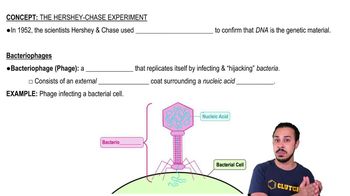
A virus that infects bacteria, used in molecular biology to study gene transfer.
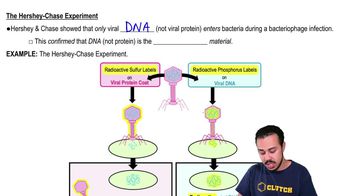
Demonstrated that DNA is the genetic material by using bacteriophages labeled with radioactive isotopes.
The basic building block of nucleic acids, consisting of a sugar, phosphate group, and nitrogenous base.
A polymer made of many nucleotides linked by phosphodiester bonds forming DNA or RNA strands.
Deoxyribonucleic acid, the molecule that stores genetic information in cells.
A segment of DNA that codes for a functional product, usually a protein.
A structure of DNA and proteins that contains genetic information; visible during cell division.
The complex of DNA and proteins in the nucleus, which condenses to form chromosomes.
DNA replication model where each new DNA molecule contains one original and one new strand.
An enzyme that synthesizes new DNA strands by adding nucleotides complementary to the template strand.
An enzyme that joins Okazaki fragments on the lagging strand during DNA replication.
The process of copying a DNA sequence into an RNA molecule.
The enzyme that synthesizes RNA from a DNA template during transcription.
The process of synthesizing a protein from an mRNA template at the ribosome.
A cellular structure where proteins are synthesized by translating mRNA.
A sequence of three nucleotides in mRNA that specifies an amino acid or stop signal during translation.
A DNA sequence where RNA polymerase binds to initiate transcription.
Messenger RNA that carries genetic information from DNA to the ribosome for protein synthesis.
Ribosomal RNA, a structural and catalytic component of ribosomes.
Transfer RNA that brings amino acids to the ribosome during protein synthesis.
The process of removing introns and joining exons in a pre-mRNA transcript.
Non-coding sequences in a gene that are removed during RNA splicing.
Coding sequences in a gene that remain in mRNA after splicing and code for protein.
An agent that causes mutations in DNA, such as chemicals or radiation.
Control of gene expression to increase or decrease the production of gene products.
A cluster of genes under control of a single promoter and operator, common in prokaryotes.
A protein that binds to the operator to block transcription of an operon.
A DNA segment where a repressor binds to regulate gene transcription.
The process by which cells become specialized in structure and function.
Proteins around which DNA winds to form nucleosomes, aiding in chromatin structure.
The basic unit of DNA packaging, consisting of DNA wrapped around histone proteins.
The process by which one X chromosome in female mammals is silenced to balance gene dosage.
Heritable changes in gene expression without altering the DNA sequence, such as DNA methylation.
A protein that binds to specific DNA sequences to regulate transcription.
A process allowing a single gene to code for multiple proteins by splicing mRNA differently.
Small RNA molecules that regulate gene expression by degrading mRNA or blocking translation.
Genes that control the body plan and the formation of structures during development.
A technique to detect specific DNA or RNA sequences by base pairing with a labeled probe.
A tool to measure the expression of many genes simultaneously using hybridization on a chip.
A series of molecular events by which a cell responds to external signals.
A normal gene that can become an oncogene due to mutations or increased expression.
A mutated or overexpressed gene that can cause cancer by promoting uncontrolled cell growth.
A gene that protects a cell from cancer; loss of function can lead to tumor development.
A substance or agent that can cause cancer by inducing mutations or promoting cell proliferation.
The process of making identical copies of a gene or DNA segment.
DNA molecules formed by combining DNA from different sources.
An enzyme that cuts DNA at specific sequences, used in genetic engineering.
Single-stranded overhangs created by restriction enzymes that facilitate DNA fragment joining.
A labeled single-stranded DNA or RNA used to detect complementary sequences.
Complementary DNA synthesized from an mRNA template using reverse transcriptase.
A genome editing tool that allows precise modification of DNA sequences.
An organism whose genome has been altered by genetic engineering techniques.
An organism that contains genes from another species introduced by genetic engineering.
A technique to treat genetic disorders by inserting functional genes into a patient's cells.
A method to identify individuals based on unique patterns in their DNA.
A technique to amplify specific DNA sequences exponentially using primers and DNA polymerase.
A short DNA sequence that provides a starting point for DNA synthesis in PCR.
A method to separate DNA fragments by size using an electric field in a gel matrix.
Repeating sequences of 2-5 base pairs in DNA used in DNA profiling.
A sequencing approach that breaks the genome into small fragments, sequences them, and assembles the data.
The use of computational tools to analyze and interpret biological data, especially genetic sequences.
The large-scale study of proteins, their structures, and functions.