 Back
BackGeneral Biology Exam Review Flashcards
 01:35
01:35
Terms in this set (29)
A testable, falsifiable explanation for an observation, based on prior knowledge and predictive, not a guess.
The factor you change on purpose in an experiment; the cause.
The factor you measure in an experiment; the effect.
Conditions kept the same across groups to ensure the IV is the only difference.
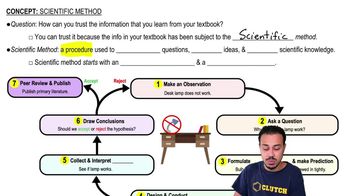
Observation, Question, Hypothesis, Experiment, Data collection, Analysis, Conclusion.
Number of protons in an atom's nucleus.
Electrons in the outermost shell that determine bonding capacity.
Bond formed when atoms share electrons. Can be nonpolar (equal sharing) or polar (unequal sharing).
Bond formed when one atom donates and another accepts electrons, creating charged ions.
Hydrophilic substances dissolve in water (polar/ionic); hydrophobic do not (nonpolar molecules).
Weak bond between a partially positive hydrogen and a partially negative atom (O, N, F) on another molecule.
Carbon has 4 valence electrons, forms 4 stable covalent bonds, and can create diverse chains and rings.
Six most prevalent elements in life: Carbon, Hydrogen, Nitrogen, Oxygen, Phosphorus, Sulfur.
Carbohydrates, Lipids, Proteins, Nucleic Acids.
Process that builds polymers by removing water to form bonds.
Process that breaks polymers by adding water to break bonds.
Prokaryotes lack nucleus and organelles; Eukaryotes have nucleus and membrane-bound organelles.
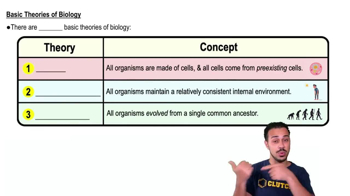
All living things are made of cells; cells are basic units of life; all cells come from preexisting cells.
Site of ATP production through cellular respiration.
Describes plasma membrane as a fluid phospholipid bilayer with embedded proteins forming a mosaic.
Catabolic breaks down molecules and releases energy; anabolic builds molecules and requires energy.
Cell's energy currency, coupling energy release and energy use.
Glucose + oxygen → carbon dioxide + water + ATP; \(\mathrm{C_6H_{12}O_6 + 6 O_2 \rightarrow 6 CO_2 + 6 H_2O + ATP}\)
Carbon dioxide + water + light → glucose + oxygen; \(6 CO_2 + 6 H_2O + \text{light} \rightarrow C_6H_{12}O_6 + 6 O_2\)
Mitosis: one division, 2 identical diploid cells; Meiosis: two divisions, 4 unique haploid gametes.
Alleles separate during gamete formation so each gamete carries one allele.
A pairs with T; C pairs with G; strands are complementary and antiparallel.
Helicase unwinds DNA; Primase adds RNA primers; DNA polymerase III builds new DNA; Ligase seals fragments.
Transcription: DNA → mRNA in nucleus; Translation: mRNA → polypeptide in cytoplasm/ribosome.