 Back
BackGeneral Biology: Exploring Life
 02:09
02:09

Terms in this set (21)
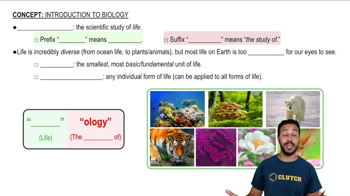
Biology is the scientific study of life.
Order, Reproduction, Growth and Development, Response to the Environment, Energy Processing, Regulation, Evolutionary Adaptation.
Domain Bacteria, Domain Archaea, Domain Eukarya.
Taxonomy is the branch of biology that classifies organisms and names them using binomial nomenclature (genus and species).
Simple, small, lack membrane-enclosed organelles, found in Bacteria and Archaea domains.
Larger than prokaryotes, have membrane-enclosed organelles, found in Domain Eukarya.
Extreme environments such as high salt (halophiles), heat or acidic pools (thermophiles), and oxygen-free areas (methanogens).
Atoms, Molecules, Organelles, Cells, Tissues, Organs, Organ Systems, Organism, Population, Community, Ecosystem, Landscape, Biosphere.
Evolution, Flow of Information, Structure and Function, Transfer & Transformation of Energy & Matter, Interactions within & between systems.
Evolution is the process of change over generations, defined as descent with modification, driven by natural selection.
Natural selection is the mechanism of evolution where populations change over time based on traits that increase reproductive success.
DNA is transcribed into RNA, which is then translated into protein during gene expression.
Structure of biological components correlates with their function, e.g., protein shape determines its role, nerve cell extensions transmit impulses.
Energy enters as sunlight, is converted to chemical energy by producers (autotrophs), passed to consumers (heterotrophs), and exits as heat.
Systems biology studies interactions among parts of biological systems to understand complexity within and between ecosystems.
Observation, Question, Gather Information, Hypothesis, Experiment, Analyze Results, Conclusion.
A testable, educated guess stated as an 'If, then' statement to explain a problem or question.
Independent variable is manipulated (cause), dependent variable is the observed effect or response.
A control is a sample with known features that remains unchanged to provide a basis for comparison.
Quantitative data is numerical; qualitative data is descriptive, such as color or behavior.
Data is best presented using graphs with clear titles, labeled axes including units, to summarize results concisely.