 Back
BackGeneral Biology Final Exam Key Concepts
 08:02
08:02
Terms in this set (22)
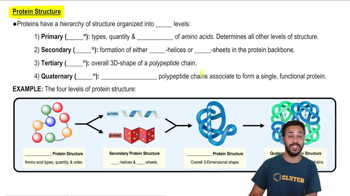
Primary: amino acid sequence; Secondary: alpha helices and beta sheets via hydrogen bonds; Tertiary: 3D folding via noncovalent interactions; Quaternary: multiple polypeptide subunits assembled.
Include hydrogen bonds, ionic bonds, hydrophobic interactions, and van der Waals forces that stabilize protein folding and function.
Changes in pH, temperature, ionic strength, and presence of inhibitors can alter enzyme shape and activity.
Bind to the enzyme's active site, competing with substrate; can be reversible or irreversible; reduce enzyme activity by blocking substrate binding.
Compare reaction rates with and without inhibitor; use assays to determine changes in Vmax and Km.
Binding of molecules at sites other than the active site modulates enzyme activity; negative feedback inhibits, phosphorylation often activates enzymes.
\(6CO_2 + 6H_2O + light \rightarrow C_6H_{12}O_6 + 6O_2\); CO2 is reduced to glucose, water is oxidized to oxygen.
\(C_6H_{12}O_6 + 6O_2 \rightarrow 6CO_2 + 6H_2O + ATP\); glucose is oxidized, oxygen is reduced.
Light energy excites electrons in PSII, generating ATP via electron transport and proton gradient; PSI uses electrons to reduce NADP+ to NADPH.
ATP provides energy and NADPH provides reducing power for the Calvin cycle to fix carbon into sugars.
CO2 fixation by RuBisCO, reduction of 3-PGA to G3P using ATP and NADPH, and regeneration of RuBP to continue the cycle.
NADH donates electrons to the electron transport chain in mitochondria, creating a proton gradient that drives ATP synthesis.
Located in the inner mitochondrial membrane; transfers electrons through complexes, pumping protons to create a gradient for ATP synthase.
Upstream sequences include promoters and enhancers; downstream sequences are transcribed into pre-mRNA.
5' capping, 3' polyadenylation, and splicing remove introns; these modifications stabilize mRNA and enable translation.
Activators bind enhancers, RNA polymerase binds promoter; transcription copies the template (antisense) DNA strand into RNA.
mRNA binds small ribosomal subunit; initiator tRNA pairs with start codon; large subunit joins to form functional ribosome.
tRNAs bring amino acids to ribosome; peptide bonds form; ribosome moves along mRNA to synthesize polypeptide chain.
Extracellular signals: polar (bind membrane receptors) and non-polar (bind intracellular receptors); receptor types include GPCR, RTK, ion channels, and intracellular receptors.
Ligand binds GPCR, activates G protein, stimulates adenylate cyclase to produce cAMP, which activates protein kinase A leading to glycogen breakdown.
Ligand (e.g., PDGF) binds RTK, receptor dimerizes and autophosphorylates, triggering a cascade that activates gene transcription for cell division.
Cancer results from uncontrolled cell division; mutations in RTK or downstream proteins (e.g., Ras) can cause pathway overactivation.