 Back
BackGeneral Biology Flashcards
 03:14
03:14
Terms in this set (61)
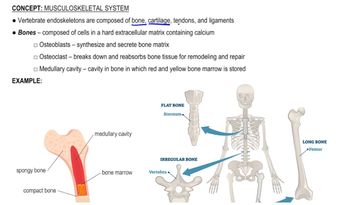
Skull, Clavicle (Collarbone), Sternum (Breastbone), Spine, Humerus, Ribcage, Radius, Ulna, Femur, Patella (Kneecap), Tibia, Fibula.
Muscle attachment, Protection, and Support.
A tendon attaches a muscle to a bone, enabling movement.
A ligament attaches bone to bone at a joint, stabilizing it.
Hip joint and Shoulder joint.
Knee and Elbow joints.
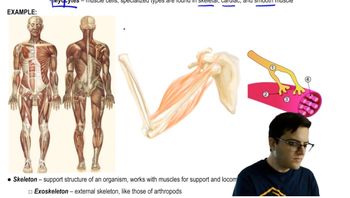
When lifting the forearm, the bicep contracts pulling the radius, while the triceps relax to allow movement.
Add iodine solution; it changes from orange to blue/black if starch is present.
Add Benedict’s solution and heat in a water bath; it changes from blue to brick red if sugar is present.
Digestion is the breakdown of large food molecules into small soluble molecules.
Physical breakdown of food into smaller pieces by teeth and stomach churning.
Enzymes and acids break down food molecules into smaller, soluble molecules.
Muscular walls churn and mix food with gastric juices, physically breaking it down.
Produces bile which helps break down fats in the small intestine.
Main site of nutrient absorption into the bloodstream.
Absorbs water from undigested food.
Produces enzymes to help digest food.
Connects mouth to stomach and moves food down by squeezing.
The brain and spinal cord.
Coordinates information from sensory organs to control behavior.
Electrical impulses.
Retina, lens, optic nerve, cornea, iris, and pupil.
Protects the eye and helps focus light.
Seeing with two eyes; helps judge distance and direction.
Captures light and converts it into electrical signals.
Transmits electrical signals from the eye to the brain.
Allows light to enter the eye.
Muscle that changes pupil size to control light entry.
A muscular pump that circulates blood.
Deoxygenated blood enters right atrium → right ventricle → lungs for oxygen → left atrium → left ventricle → body via aorta.
Supply the heart muscle with oxygen and nutrients.
An electrical fault causing the heart to stop pumping blood.
Blockage in coronary arteries causing heart muscle damage due to lack of oxygen.
Gradual change of organisms over generations relying on variation.
Structural: blubber for insulation, camouflage coloring, waterproof feathers. Behavioural: tobogganing on ice, huddling for warmth.
Organisms best adapted survive and pass on their genes.
One parent produces genetically similar offspring.
Two parents combine gametes to produce offspring.
Testes produce sperm; sperm duct transports sperm to urethra.
Ovaries produce eggs; oviduct (fallopian tube) connects ovaries to uterus.
Monthly release of a mature egg from an ovary.
Fusion of sperm and egg nuclei forming a zygote.
Zygote embeds itself in the uterus wall.
Flask-like structure holding ovules.
Sticky structure that traps pollen.
Elongated structure holding stigma for pollination.
Contains female gametes; plant equivalent of an egg.
All female parts of the flower.
Protective, often colorful and scented layer in insect-pollinated flowers.
All male parts of the flower.
Pollen-producing structure that releases pollen.
Long thin structure holding anther in position.
Protect flower bud; may be colorful in insect-pollinated flowers.
Produce sugary nectar in insect-pollinated flowers.
Transfer of pollen from anther to stigma by wind or insects.
Pollen grows tube through style to ovary; male gametes fertilise ovule.
Embryo, food store (cotyledon), seed coat.
To move seeds away from parent, reducing competition for resources.
Seeds resist digestion and are deposited in animal droppings.
Seeds with hooks attach to animal fur and fall off later.
Seeds have lightweight, feathery or papery fruit that catch the wind.