 Back
BackGeneral Biology: Gene Expression, Evolution, and Speciation
 07:44
07:44
Terms in this set (29)
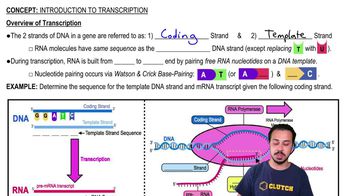
Transcription is the process of copying DNA into mRNA. It occurs in the nucleus of eukaryotic cells.
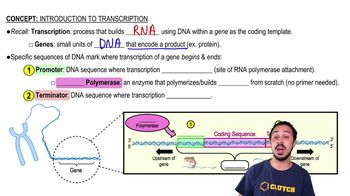
RNA polymerase is the key enzyme that synthesizes mRNA from the DNA template during transcription.
The promoter is a DNA sequence where RNA polymerase and transcription factors bind to initiate transcription.
The TATA box is a DNA sequence in the promoter region that transcription factors bind to start transcription.
Introns are non-coding sequences removed during RNA splicing; exons are coding sequences joined to form mature mRNA.
RNA splicing removes introns from pre-mRNA. The spliceosome is the complex that carries out this process.
Alternative splicing allows a single gene to produce multiple protein variants by including or excluding different exons.
The triplet code is a sequence of three nucleotides coding for an amino acid. A codon is the mRNA triplet; an anticodon is the complementary tRNA triplet.
The start codon is AUG, which codes for the amino acid methionine.
The genetic code is redundant because multiple codons can code for the same amino acid.
Translation is the process of synthesizing proteins from mRNA. It occurs in the cytoplasm on ribosomes.
tRNA molecules carry specific amino acids and have anticodons that pair with mRNA codons during translation.
The wobble position is the third nucleotide in a codon, allowing flexible base pairing and reducing the effect of mutations.
Aminoacyl-tRNA synthetase attaches the correct amino acid to its corresponding tRNA.
The P site holds the tRNA with the growing polypeptide, the A site holds the incoming aminoacyl-tRNA, and the E site is where tRNA exits.
Initiation: ribosome assembles on mRNA; Elongation: amino acids are added; Termination: stop codon signals release of the polypeptide.
A point mutation is a change in a single nucleotide in DNA.
A silent mutation changes a nucleotide but does not change the amino acid due to genetic code redundancy.
A missense mutation changes a nucleotide and results in a different amino acid in the protein.
A nonsense mutation changes a codon to a stop codon, prematurely terminating protein synthesis.
Insertion or deletion mutations add or remove nucleotides, often causing frameshifts that disrupt protein function.
Evolution is the change in the genetic composition of a population over time.
Charles Darwin wrote The Origin of Species in 1859, proposing natural selection as the mechanism of evolution.
Natural selection is the process where individuals with advantageous traits reproduce more successfully, leading to evolution.
Homologous structures are anatomical features shared by species due to common ancestry.
Genetic drift is a random change in allele frequencies in a population, especially in small populations.
Gene flow is the transfer of alleles between populations through migration.
Speciation is the process by which new species arise from existing ones.
Allopatric speciation occurs due to geographic isolation; sympatric speciation occurs without geographic separation.