 Back
BackGeneral Biology: Gene Expression, Evolution, and Speciation
 07:44
07:44
Terms in this set (35)
A cell that expresses specific genes to perform specialized functions, despite having the same DNA as other cells.
mRNA acts as the messenger carrying genetic information from DNA to the ribosome for protein synthesis.
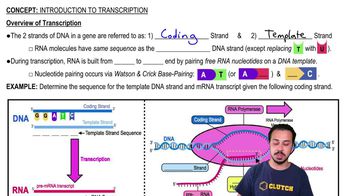
Process of copying DNA into RNA; occurs in the nucleus with RNA polymerase as the key enzyme.
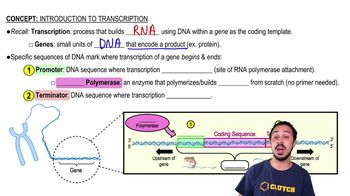
A DNA sequence where RNA polymerase and transcription factors bind to initiate transcription.
Proteins that bind to the promoter or other DNA sequences to regulate transcription initiation.
Initiation: RNA polymerase binds promoter; Elongation: RNA strand is synthesized 5’ to 3’; Termination: RNA polymerase detaches at terminator sequence.
A DNA promoter sequence where transcription factors bind to help position RNA polymerase for transcription start.
5’ cap addition, poly-A tail addition, and RNA splicing occur in the nucleus to produce mature mRNA.
Introns are non-coding sequences removed during RNA splicing; exons are coding sequences joined to form mature mRNA.
A complex that removes introns and joins exons during RNA splicing.
Process allowing a single gene to code for multiple proteins by splicing RNA in different ways.
Original idea that one gene codes for one protein; challenged by alternative splicing and multifunctional proteins.
Triplet code: three-nucleotide sequences in mRNA; codon: mRNA triplet; anticodon: complementary tRNA triplet.
AUG is the start codon and codes for methionine.
Codons that signal translation termination; examples include UAA, UAG, UGA.
Multiple codons can code for the same amino acid, providing redundancy.
tRNA carries specific amino acids and has an anticodon that pairs with mRNA codons during translation.
The third nucleotide in a codon that allows flexible base pairing, contributing to genetic code redundancy.
Enzyme that attaches the correct amino acid to its corresponding tRNA.
Ribosomes are made of rRNA and proteins; have P (peptidyl), A (aminoacyl), and E (exit) sites for tRNA binding during translation.
Initiation: assembly of ribosome and start codon recognition; Elongation: amino acid chain elongation; Termination: release at stop codon.
Free ribosomes synthesize proteins for cytosol; bound ribosomes synthesize proteins for membranes or secretion.
Silent (no amino acid change), missense (amino acid change), nonsense (premature stop codon).
Addition or loss of nucleotides causing frameshift mutations that alter protein reading frame.
Includes promoter, operator, structural genes, repressor, and regulatory gene controlling gene expression in prokaryotes.
Repressor binds operator to turn off operon when tryptophan (corepressor) is abundant; operon is on when tryptophan is low.
Produces enzymes to metabolize lactose; turned on when lactose is present and glucose is low.
Change in allele frequencies in a population over time.
Variation, heritability, and differential reproductive success.
Homologous: shared ancestry; analogous: similar function but different ancestry (convergent evolution).
Process by which new species arise from existing ones.
Reproductive isolating mechanisms preventing fertilization (e.g., temporal, behavioral, mechanical isolation).
Barriers after fertilization causing hybrid inviability or sterility.
Allopatric: geographic isolation; sympatric: speciation without geographic separation.
Evolutionary model with long periods of stasis interrupted by rapid change.