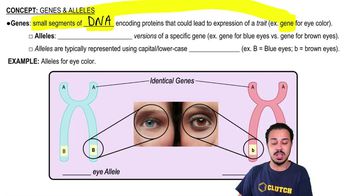
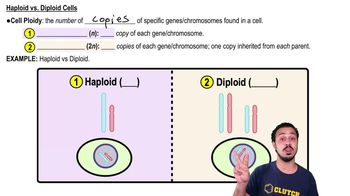
An allele is an alternative form of the same gene. Dominant alleles mask recessive alleles and are represented by uppercase letters; recessive alleles are expressed only in homozygous recessive individuals and are lowercase.
Define homozygous and heterozygous genotypes.
Homozygous means having two identical alleles for a gene (e.g., BB or bb). Heterozygous means having two different alleles for a gene (e.g., Bb).
What is a Punnett square used for?
A Punnett square is a diagram used to predict the probability of genotypes and phenotypes of offspring from a genetic cross.
Explain complete dominance.
In complete dominance, the dominant allele masks the recessive allele in heterozygous individuals, so the dominant trait is expressed.
What is incomplete dominance?
Incomplete dominance occurs when a heterozygote shows an intermediate phenotype between the two homozygous phenotypes, such as pink flowers from red and white snapdragons.
Describe codominance and give an example.
Codominance is when both alleles are fully expressed in a heterozygote. Example: human blood type AB expresses both A and B alleles.
What are multiple alleles?
Multiple alleles means more than two alleles exist for a gene in a population, though each individual has only two. Example: human blood types (IA, IB, i).
Define polygenic inheritance.
Polygenic inheritance involves multiple genes influencing a single trait, resulting in a continuous range of phenotypes, like human height or eye color.
What is epistasis?
Epistasis occurs when one gene interferes with or masks the expression of another gene at a different locus, such as albinism affecting pigment genes.
How can the environment influence phenotype?
Environmental factors can affect gene expression and phenotype, e.g., temperature affecting fur color in Siamese cats or sun exposure increasing freckles.
What is pleiotropy?
Pleiotropy is when one gene influences multiple phenotypic traits, such as the gene causing cystic fibrosis affecting mucus, sweat, and liver function.
Explain sex-linked traits and why X-linked recessive traits affect males more.
Sex-linked traits are controlled by genes on sex chromosomes. X-linked recessive traits affect males more because males have only one X chromosome, so recessive alleles are expressed.
What is a Barr body?
A Barr body is an inactivated X chromosome in female cells, leading to mosaic expression of X-linked genes, such as fur color patterns in calico cats.
Define aneuploidy and give an example.
Aneuploidy is the gain or loss of chromosomes, e.g., trisomy 21 causes Down syndrome with three copies of chromosome 21.
What is the role of helicase in DNA replication?
Helicase unwinds and separates the two DNA strands by breaking hydrogen bonds, creating replication forks.
Describe the difference between leading and lagging strands during DNA replication.
The leading strand is synthesized continuously 5’ to 3’, while the lagging strand is synthesized discontinuously as Okazaki fragments.
What is the function of DNA polymerase III?
DNA polymerase III adds nucleotides to the growing DNA strand during replication, synthesizing new DNA complementary to the template.
Why are RNA primers needed in DNA replication?
RNA primers provide a starting 3’ end for DNA polymerase to add DNA nucleotides, since DNA polymerase cannot initiate synthesis de novo.
What is semiconservative replication?
In semiconservative replication, each new DNA molecule consists of one original (parental) strand and one newly synthesized strand.
What are telomeres and their significance?
Telomeres are repetitive DNA sequences at chromosome ends that protect genes from loss during replication; they shorten with each cell division.
What is transcription and where does it occur?
Transcription is the process of copying DNA into RNA, occurring in the nucleus of eukaryotic cells.
What modifications occur to pre-mRNA before it leaves the nucleus?
Pre-mRNA receives a 5’ cap, a 3’ poly-A tail, and introns are spliced out to produce mature mRNA.
Define translation.
Translation is the process where ribosomes synthesize proteins by reading mRNA codons and assembling amino acids.
What is the role of tRNA in translation?
tRNA carries specific amino acids to the ribosome and matches its anticodon to mRNA codons to add amino acids to the growing protein.
What are start and stop codons?
The start codon (AUG) signals the beginning of translation; stop codons (UAA, UAG, UGA) signal termination.
What is a mutation?
A mutation is a permanent change in the DNA nucleotide sequence that can be caused by replication errors or mutagens.
Differentiate between frameshift and point mutations.
Frameshift mutations involve insertions or deletions shifting the reading frame; point mutations are single nucleotide changes.
What are transposons?
Transposons are DNA segments that can move within the genome, causing mutations by insertion or deletion.
 Back
Back
 02:09
02:09