 Back
BackGeneral Biology I - Cell Division and Genetics
 04:45
04:45
Terms in this set (28)
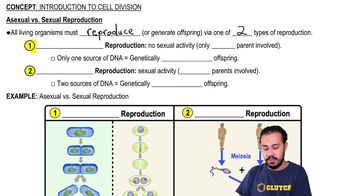
Asexual reproduction involves one parent and produces genetically identical offspring. Sexual reproduction involves two parents and produces genetically diverse offspring through meiosis and fertilization.
An unduplicated chromosome is a single DNA molecule. A duplicated chromosome consists of two sister chromatids joined at the centromere.
The cell cycle includes interphase (G1, S, G2 phases) where the cell grows and DNA replicates, followed by the mitotic phase (M phase) where mitosis and cytokinesis occur.
Prophase: chromosomes condense, spindle forms.
Prometaphase: nuclear envelope breaks down, spindle attaches.
Metaphase: chromosomes align at the metaphase plate.
Anaphase: sister chromatids separate.
Telophase: nuclear envelopes reform, chromosomes decondense.
In animal cells, cytokinesis occurs by cleavage furrow formation. In plant cells, a cell plate forms to divide the cell.
Cancer cells exhibit uncontrolled growth, ignore density-dependent inhibition and anchorage dependence, and can invade other tissues (metastasis).
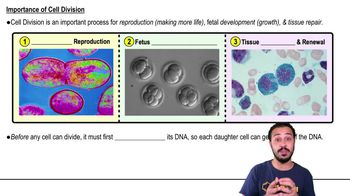
Mitosis enables growth, tissue repair, and asexual reproduction by producing genetically identical somatic cells.
Chromosomes are paired as homologous chromosomes, one from each parent, carrying genes for the same traits at corresponding loci.
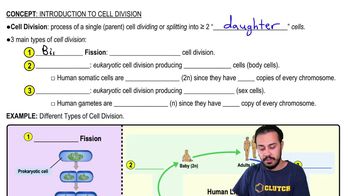
Somatic cells are diploid body cells with paired chromosomes. Gametes are haploid reproductive cells with a single set of chromosomes.
Meiosis reduces chromosome number by half to produce haploid gametes, ensuring chromosome number is restored at fertilization.
Meiosis I: Prophase I (crossing over), Metaphase I, Anaphase I (homologs separate), Telophase I.
Meiosis II: Prophase II, Metaphase II, Anaphase II (sister chromatids separate), Telophase II.
Mitosis produces two identical diploid cells for growth. Meiosis produces four genetically diverse haploid cells for sexual reproduction.
Genetic variation arises from crossing over during prophase I and independent assortment of chromosomes during metaphase I of meiosis.
Genetic diseases result from mutations in specific genes. Chromosomal disorders result from changes in chromosome number or structure.
Types include deletion, duplication, inversion, and translocation.
Cancer usually results from mutations acquired during life, not inherited mutations in germ cells.
Anaphase is the mitotic phase when sister chromatids separate and move toward opposite poles.
Anchorage dependence is the requirement that cells must be attached to a surface to divide.
Binary fission is an asexual reproduction method in prokaryotes where the cell divides into two identical cells.
The centromere is the region where sister chromatids are joined and where spindle fibers attach during mitosis.
Centrosomes organize the mitotic spindle fibers that separate chromosomes during mitosis.
A chiasma is the site where crossing over occurs between homologous chromosomes during prophase I of meiosis.
The cleavage furrow is the indentation that begins cytokinesis in animal cells.
A clone is a group of genetically identical individuals produced by asexual reproduction.
Crossing over is the exchange of genetic material between homologous chromosomes during meiosis, increasing genetic variation.
Density-dependent inhibition is the phenomenon where crowded cells stop dividing.
Diploid cells have two sets of chromosomes; haploid cells have one set.
A karyotype is an ordered display of an organism's chromosomes used to detect chromosomal abnormalities.