 Back
BackGeneral Biology I - Chapter 1 Key Concepts
 09:26
09:26
Terms in this set (33)
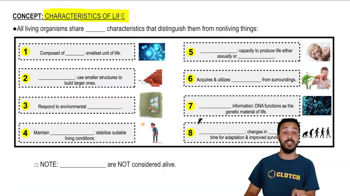
Order, regulation, growth and development, energy processing, response to environment, reproduction, and evolutionary adaptation are the seven properties common to all life.
The three domains are Bacteria, Archaea, and Eukarya, differing in cell type and genetics.
From smallest to largest: molecule, organelle, cell, tissue, organ, organ system, organism, population, community, ecosystem, biosphere.
New properties that arise at each level of biological organization due to interactions among components.
Observation, question, hypothesis, prediction, experiment, analysis, conclusion.
Includes an independent variable manipulated, a dependent variable measured, and control groups for comparison.
Human-directed breeding to select for desired traits in organisms.
The scientific study of life and living organisms.
All ecosystems on Earth where life exists.
The basic unit of life in all living organisms.
All populations of different species living and interacting in an area.
An experiment that tests a hypothesis by changing one variable while keeping others constant.
Recorded observations and measurements from experiments.
The measured outcome that responds to changes in the independent variable.
The highest taxonomic rank grouping organisms by cell type and genetics.
A community of organisms and their physical environment interacting as a system.
Change in genetic composition of populations over generations.
A segment of DNA that codes for a specific protein or trait.
The process by which information from a gene is used to produce a functional product, like a protein.
A testable explanation for a scientific question.
The factor manipulated in an experiment to test its effect.
Two or more atoms bonded together forming the chemical basis of life.
The process where organisms better adapted to their environment tend to survive and reproduce.
A structure composed of multiple tissues performing a specific function.
A group of organs working together to perform a body function.
A specialized structure within a cell that performs a specific function.
An individual living entity.
A group of individuals of the same species living in an area.
A systematic approach to understanding the natural world through observation and experimentation.
The study of interactions among components of biological systems.
Application of scientific knowledge for practical purposes.
A well-supported explanation of natural phenomena based on evidence.
A group of similar cells performing a common function.