 Back
BackGeneral Biology - Introduction and Scientific Inquiry
 09:26
09:26
Terms in this set (20)
Biology is the study of life and living organisms, including their structure, function, growth, evolution, and interactions.
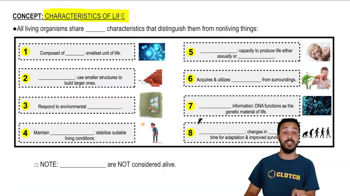
Reproduction, Growth and Development, Order, Response to Environment, Energy Processing, Regulation, Evolutionary Adaptation.
Emergent properties are new characteristics that arise at each level of biological hierarchy due to interactions among components.
Biological structures are shaped to perform specific functions, e.g., bone structure supports and protects the body.
DNA provides heritable genetic information essential for life processes and reproduction.
Life requires the transfer and transformation of energy and matter, such as plants converting light energy into chemical energy.
Interactions occur at molecular, organismal, and ecosystem levels, influencing biological functions and environmental balance.
Scientific inquiry involves asking questions, forming hypotheses, conducting experiments, and drawing conclusions to understand biological phenomena.
Discovery-based uses inductive reasoning to observe and describe; hypothesis-based uses deductive reasoning to test predictions.
A hypothesis is a testable and falsifiable statement that explains an observation and predicts an outcome.
It must be possible to design experiments that can support or contradict the hypothesis.
Includes a control group, experimental group, independent variable (manipulated), and dependent variable (measured).
The independent variable is changed by the experimenter; the dependent variable responds to that change.
The control group is not exposed to the independent variable; the experimental group is exposed.
Quantitative data is numerical; qualitative data describes qualities or characteristics.
A theory is a well-supported explanation based on many tested hypotheses; a hypothesis is a single testable idea.
It is the process by which species change over time, inheriting traits from common ancestors.
Individuals with traits better suited to their environment survive and reproduce more successfully, driving evolution.
Negative feedback reduces a change, helping maintain homeostasis, e.g., insulin regulating blood glucose.
Positive feedback amplifies a change, often driving processes to completion, e.g., blood clotting.