 Back
General Biology: Introduction, Evolution, and Scientific Method
 02:09


Terms in this set (25)
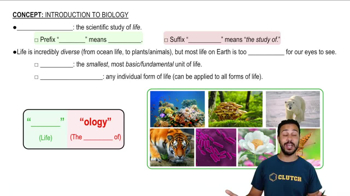
Biology is the scientific study of life.
The prefix bio- means life.
The suffix -ology means the study of.
The cell is the smallest, most basic unit of life.
An organism is any individual form of life, applicable to all forms of life.
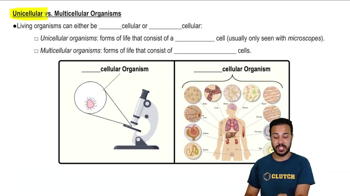
Unicellular organisms consist of a single cell; multicellular organisms consist of many cells.
1) Composed of cells.
2) Hierarchical organization.
3) Respond to environment.
4) Maintain homeostasis.
5) Reproduce.
6) Metabolism using energy.
7) Contain genetic information (DNA).
8) Evolution over time.
Homeostasis is the maintenance of stable internal conditions suitable for life.
Atom → Molecule → Organelle → Cell → Tissue → Organ → Organ System → Organism → Population → Community → Ecosystem → Biosphere.
Emergent properties arise when smaller parts combine to form a whole that has new functions not seen in individual parts.
Adaptation is the process that enables organisms to improve survival and reproduction in their environment.
Fitness is an organism's ability to survive and reproduce.
Natural selection is the process where the environment selects for organisms with traits that increase fitness.
1) Genetic variation in a population.
2) Selective pressure for heritable traits affecting fitness.
Evolution is the change in the genetic makeup of a population over multiple generations.
Taxonomy is the branch of science that classifies, identifies, and names organisms.
Bacteria, Archaea, and Eukarya.
Eukarya consist of eukaryotic cells that contain a nucleus; Bacteria and Archaea are prokaryotic and lack a nucleus.
1) Autotrophs (producers) make their own food.
2) Heterotrophs (consumers) eat other organisms.
3) Decomposers obtain energy from dead organisms and waste.
A procedure to ask questions, test ideas, and build scientific knowledge through observation, hypothesis, experimentation, and analysis.
A hypothesis is a proposed, testable explanation for an observation that can generate predictions.
A theory is a well-supported, testable explanation based on many observations and evidence.
Independent variable is manipulated by the researcher.
Dependent variable is measured and affected by the independent variable.
False positive: test indicates a result when it is not true.
False negative: test fails to indicate a result when it is true.
Positive control: group expected to show a positive result.
Negative control: group expected to show no effect.