 Back
BackGeneral Biology: Introduction to Animals
 06:59
06:59
Terms in this set (28)
Animals are eukaryotes that are multicellular with cells lacking cell walls, are heterotrophic (ingest food), and exhibit motility at some life stage.
Multicellularity likely originated in a sponge-like animal, with sponges (phylum Porifera) representing the most basal animal lineages.
Sponges share traits with choanoflagellates: both are benthic, sessile, and choanoflagellates form colonies. Sponges have specialized cells and extracellular matrix.
Spicules are stiff spikes of silica or calcium carbonate that provide structural support to the sponge's extracellular matrix.
The ctenophores-first hypothesis suggests ctenophores are sister to all other animals, lacking microRNAs, but evidence is insufficient to reject sponges-first.
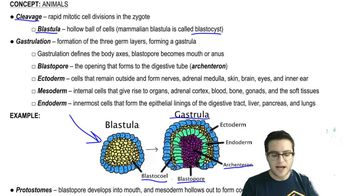
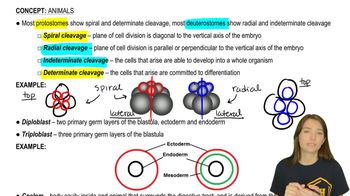
Diploblasts have two germ layers: ectoderm and endoderm. Triploblasts have three: ectoderm, endoderm, and mesoderm.
Ectoderm forms skin and nervous system; endoderm forms digestive tract lining; mesoderm forms circulatory system, muscles, bones, and organs.
Contractile proteins actin and myosin are homologous in all animals; ctenophores and cnidarians have epitheliomuscular cells derived from ectoderm/endoderm, functionally similar to mesodermal muscle.
Radial symmetry has multiple planes of symmetry (e.g., cnidarians), while bilateral symmetry has a single plane and is associated with cephalization.
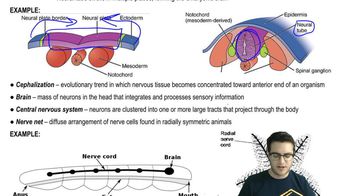
Sponges lack nerves; radially symmetric animals have nerve nets; bilaterians have diverse nervous systems including centralized CNS and ganglia, linked to cephalization.
A coelom is a fluid-filled body cavity lined with mesoderm, allowing organ movement and circulation of oxygen and nutrients.
Coelomates have a fully mesoderm-lined cavity; pseudocoelomates have a partially lined cavity; acoelomates lack a body cavity.
Protostomes develop mouth first; deuterostomes develop anus first during embryonic development.
Lophotrochozoans (mollusks, annelids) grow continuously; Ecdysozoans (arthropods, nematodes) grow by molting exoskeletons.
Segmentation is the division of the body into repeated units; prominent in vertebrates, annelids, and arthropods.
Cephalization is the concentration of sensory organs and nervous tissue in the head, enhancing environmental sensing and processing.
Animals can detect magnetic fields, electric fields, barometric pressure, and gravity, aiding navigation and prey detection.
Animals can be detritivores, herbivores, carnivores, omnivores, or parasites (endo- or ectoparasites) based on their feeding habits.
Suspension feeders, deposit feeders, fluid feeders, and mass feeders differ in how they obtain food.
Hydrostatic skeletons use fluid pressure; endoskeletons are internal rigid supports; exoskeletons are external rigid coverings.
Animals reproduce sexually or asexually; asexual methods include fission, budding, and parthenogenesis.
Viviparous species retain embryos internally; oviparous species lay eggs externally; ovoviviparous species retain eggs internally but nourish embryos via yolk.
Indirect development includes larval stages distinct from adults; metamorphosis transforms larvae into juveniles, which mature into adults.
Sponges are sessile, mostly marine suspension feeders with diverse sizes and shapes, lacking true tissues but having specialized cells.
Mostly planktonic predators with sticky cells for prey capture, lacking stinging cells, and having cilia for locomotion.
Marine animals with cnidocytes for prey capture, including jellyfish, corals, and anemones; many have polyp and medusa stages.
Corals build calcium carbonate skeletons and have mutualistic relationships with photosynthetic protists that provide nutrients.
Global warming and ocean acidification cause coral bleaching by killing symbiotic algae, threatening reef ecosystems.