 Back
BackGeneral Biology: Introduction to Metabolism
 02:17
02:17
Terms in this set (20)
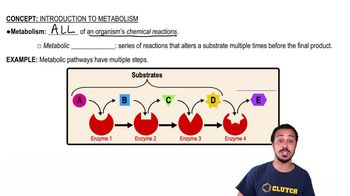
Metabolism is the totality of an organism's chemical reactions, managing the material and energy resources of the cell.
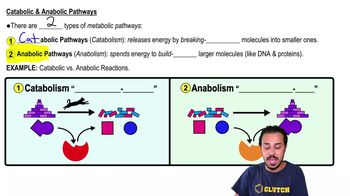
Catabolic pathways release energy by breaking down complex molecules into simpler ones.
Anabolic pathways consume energy to build complex molecules from simpler ones.
The first law states that energy cannot be created or destroyed, only transformed or transferred.
The second law states that every energy transfer increases the entropy (disorder) of the universe.
Free energy is the portion of a system's energy that can perform work when temperature and pressure are uniform.
A negative \(\Delta G\) means the reaction is spontaneous and can perform work.
An exergonic reaction releases energy and has a negative \(\Delta G\).
An endergonic reaction absorbs energy and has a positive \(\Delta G\).
ATP stores energy in its phosphate bonds and releases it by hydrolysis, converting to ADP and inorganic phosphate.
Enzymes act as catalysts to speed up chemical reactions without being consumed.
Activation energy is the initial energy needed to start a chemical reaction.
Enzymes stabilize the transition state, reducing the energy required to reach it.
The active site is the region where the substrate binds and the reaction occurs.
Induced fit is the change in enzyme shape that enhances substrate binding.
Enzymes have optimal temperature and pH; deviations can reduce activity or denature the enzyme.
Feedback inhibition occurs when the end product of a pathway inhibits an earlier enzyme to regulate the pathway.
Competitive inhibitors bind the active site; noncompetitive inhibitors bind elsewhere, changing enzyme shape.
Because products of one reaction serve as substrates for the next, forming metabolic pathways.
Energy coupling uses exergonic reactions to drive endergonic ones, often via ATP hydrolysis.