Skip to main content
General Biology
My Course
Learn
Exam Prep
AI Tutor
Study Guides
Textbook Solutions
Flashcards
Explore
Try the app
My Course
Learn
Exam Prep
AI Tutor
Study Guides
Textbook Solutions
Flashcards
Explore
Try the app
Back
General Biology Key Concepts
You can tap to flip the card.
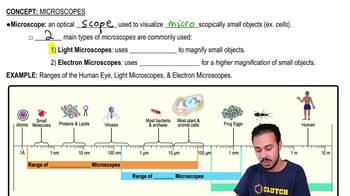
Range of object sizes for light microscope
You can tap to flip the card.
👆
Range of object sizes for light microscope
Light microscopes visualize objects roughly from 200 nm to 1 mm; smaller structures require electron microscopes.
Track progress
Control buttons has been changed to "navigation" mode.
1/30
Recommended videos
06:35
Microscopes
24960
views
569
rank
02:52
Types of Electron Microscopes
17908
views
357
rank
1
comments
Terms in this set (30)
Hide definitions
Range of object sizes for light microscope
Light microscopes visualize objects roughly from 200 nm to 1 mm; smaller structures require electron microscopes.
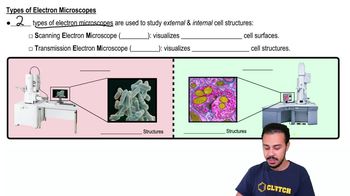
Difference between SEM and TEM
SEM scans surfaces producing 3D images; TEM transmits electrons through thin samples for internal structure.
Purpose of stains in light microscopy
Stains increase contrast by coloring specific cell components, making structures visible under light microscopes.
Function of cell fractionation
Cell fractionation separates cellular components by size and density for detailed study.
Organelles found in both plant and animal cells
Nucleus, mitochondria, ER, Golgi apparatus, ribosomes, peroxisomes, cytoskeleton.
Organelles unique to plant cells
Chloroplasts, central vacuole, cell wall, plasmodesmata.
Role of ribosomes
Ribosomes synthesize proteins by translating mRNA.
Nuclear envelope and nuclear pores
The nuclear envelope is a double membrane surrounding the nucleus; nuclear pores regulate molecule passage.
Functions of smooth and rough ER
Smooth ER synthesizes lipids and detoxifies; rough ER has ribosomes and synthesizes proteins.
Role of the Golgi apparatus
Modifies, sorts, and packages proteins and lipids for secretion or delivery.
What are lysosomes?
Lysosomes contain enzymes that digest macromolecules and recycle cellular waste.
Phagocytosis definition
Phagocytosis is the process of engulfing large particles or cells for digestion.
What is the tonoplast?
The tonoplast is the membrane surrounding the central vacuole in plant cells.
Function of mitochondria
Mitochondria generate ATP through cellular respiration.
Endosymbiont theory evidence
Mitochondria and chloroplasts have double membranes, own DNA, and reproduce independently.
Components of the cytoskeleton
Microtubules (tubulin), microfilaments (actin), intermediate filaments (varied proteins).
Function of motor proteins kinesin and dynein
They move cargo along microtubules using ATP.
Structural organization of cilia and flagella
9+2 arrangement of microtubules with dynein arms for movement.
Primary vs secondary plant cell walls
Primary walls are flexible and formed first; secondary walls are thicker and rigid.
Types of animal cell junctions
Tight junctions (seal cells), desmosomes (anchor cells), gap junctions (communication).
Main components of the plasma membrane
Phospholipid bilayer with embedded proteins, cholesterol, glycolipids, and glycoproteins.
Fluid mosaic model
Membrane is a fluid bilayer of lipids with proteins floating within.
Difference between active and passive transport
Active transport requires energy to move substances against gradients; passive transport does not.
Osmosis definition
Diffusion of water across a selectively permeable membrane.
Membrane potential
Voltage difference across a membrane due to ion distribution.
Sodium-potassium pump function
Uses ATP to pump 3 Na+ out and 2 K+ into animal cells, maintaining gradients.
Catabolic vs anabolic pathways
Catabolic pathways break down molecules releasing energy; anabolic build molecules consuming energy.
First and second laws of thermodynamics
1st: Energy conserved; 2nd: Entropy increases in isolated systems.
Free energy and spontaneity
Negative free energy change means spontaneous (exergonic); positive means nonspontaneous (endergonic).
Role of enzymes
Enzymes lower activation energy to speed up reactions without being consumed.
 BackBack
 06:35