 Back
BackGeneral Biology Key Concepts
 01:35
01:35
Terms in this set (30)
Proximate explanations address immediate mechanisms (e.g., how cells divide). Ultimate explanations address evolutionary reasons (e.g., why cell division is advantageous).
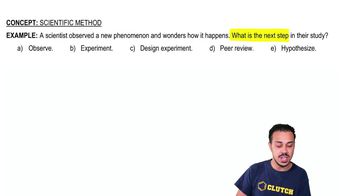
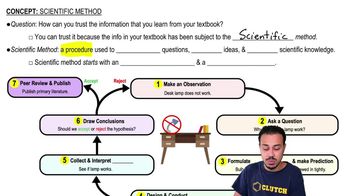
Includes control groups, independent and dependent variables, replication, and randomization to ensure valid results.
Atoms consist of a nucleus with protons and neutrons, surrounded by electron shells.
Ionic bonds, covalent bonds, and hydrogen bonds form based on electronegativity differences.
Water has covalent bonds within molecules and hydrogen bonds between molecules, leading to high specific heat, cohesion, and adhesion.
Acids donate H+ ions; bases accept H+ ions. pH measures hydrogen ion concentration and changes logarithmically with [H+].
Examples: Amino (-NH2), Carboxyl (-COOH), Hydroxyl (-OH), Methyl (-CH3), Phosphate (-PO4), Sulfhydryl (-SH).
First Law: Energy cannot be created or destroyed. Second Law: Entropy increases in spontaneous processes.
Gibbs free energy (\(\Delta G\)) determines if a reaction is spontaneous (<0) or not (>0).
Proteins (amino acids), nucleic acids (nucleotides), carbohydrates (monosaccharides), lipids (fatty acids and glycerol).
Primary: amino acid sequence; Secondary: alpha helices and beta sheets; Tertiary: 3D folding; Quaternary: multiple polypeptides.
DNA stores genetic info; RNA (mRNA, tRNA, rRNA) involved in protein synthesis and regulation.
Monosaccharides (glucose), disaccharides (sucrose), polysaccharides (starch, cellulose); energy storage and structure.
Phospholipids form membranes; fats store energy; steroids act as signaling molecules.
Phospholipids form bilayers with hydrophilic heads facing water and hydrophobic tails inward.
Diffusion, osmosis, facilitated diffusion (passive); active transport requires energy; includes channels, carriers, and pumps.
Glycolysis, pyruvate processing, citric acid cycle, electron transport chain and oxidative phosphorylation.
Lactic acid fermentation (animals), ethanol fermentation (yeast); produce less ATP than aerobic respiration.
Converts CO2 and H2O into glucose and O2 using light energy; includes light reactions and Calvin cycle.
Prokaryotes lack membrane-bound organelles; eukaryotes have nucleus and organelles like mitochondria.
Prophase, metaphase, anaphase, telophase; followed by cytokinesis.
Involves helicase, primase, DNA polymerases, ligase; leading strand synthesized continuously, lagging strand discontinuously.
Transcription produces mRNA from DNA; translation synthesizes proteins from mRNA codons using ribosomes and tRNA.
Operons control gene clusters; lac operon is inducible, trp operon is repressible; regulation via repressors and activators.
Includes chromatin modification, transcription factors, mRNA processing, and RNA interference.
Mitosis produces two identical diploid cells; meiosis produces four genetically unique haploid cells.
Law of Segregation: alleles separate during gamete formation; Law of Independent Assortment: genes assort independently.
Mutation, gene flow, genetic drift, and natural selection change allele frequencies in populations.
Population allele frequencies remain constant if no evolution occurs; described by \(p^2 + 2pq + q^2 = 1\).
Stabilizing (favors average), directional (favors one extreme), disruptive (favors both extremes).