 Back
BackGeneral Biology Key Concepts
 01:35
01:35
Terms in this set (30)
Precision is how closely measured values agree with each other, indicating consistency.
Accuracy is how closely measured values agree with the true or correct value.
The dependent variable is the factor being measured and predicted to be affected by changes in the independent variable.
The independent variable is the variable that is changed or manipulated during an experiment.
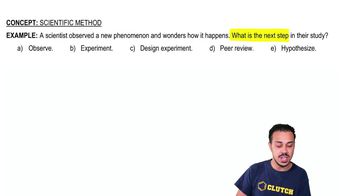
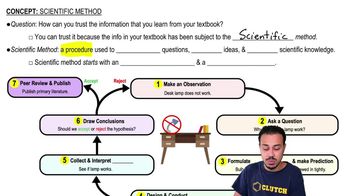
A hypothesis is a clear statement defining the specifics of the experimental variables being tested.
Density is defined as mass per unit volume, commonly expressed in grams per milliliter (g/ml).
Atomic structure refers to the arrangement of protons, neutrons, and electrons in an atom.
A covalent bond is a chemical bond where atoms share electron pairs.
An ionic bond is formed when one atom donates electrons to another, creating oppositely charged ions.
A hydrogen bond is a weak attraction between a hydrogen atom and an electronegative atom like oxygen or nitrogen.
The octet rule states that atoms tend to gain, lose, or share electrons to have eight electrons in their outer shell.
Dissociation is the process where molecules separate into smaller particles, ions, or atoms.
An electrolyte is a substance that dissociates into ions and conducts electricity in solution.
A cation is a positively charged ion.
An anion is a negatively charged ion.
Reactants are substances that start a chemical reaction.
Products are substances formed as a result of a chemical reaction.
A mole is a unit representing 6.022 × 10²³ particles of a substance.
Molarity is the concentration of a solution expressed as moles of solute per liter of solution.
The solvent is the substance in which the solute dissolves to form a solution.
The solute is the substance dissolved in a solvent to form a solution.
A solution is a homogeneous mixture of solute dissolved in solvent.
pH measures the acidity or basicity of a solution on a scale from 0 to 14.
A buffer is a solution that resists changes in pH when acids or bases are added.
An acid is a substance that increases hydrogen ion concentration in solution.
A base is a substance that decreases hydrogen ion concentration in solution.
Objective lenses are the primary lenses that magnify the specimen in a compound microscope.
Cytoplasmic streaming is the movement of cytoplasm within a cell to distribute nutrients and organelles.
Photosynthesis is the process by which plants convert light energy into chemical energy.
A thylakoid is a membrane-bound compartment inside chloroplasts where light-dependent reactions occur.