 Back
BackGeneral Biology: Key Concepts and Processes
 09:26
09:26
Terms in this set (16)
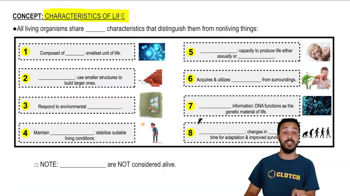
Living organisms exhibit organization, metabolism, growth, reproduction, response to stimuli, and adaptation.
Hierarchy from molecules to cells, tissues, organs, organ systems, organisms, populations, communities, ecosystems, and biosphere.
Observation, hypothesis, experimentation, data analysis, and conclusion to test ideas.
Water is cohesive, adhesive, has a high specific heat, is a good solvent, and expands when frozen.
Reaction that builds macromolecules by removing water to form bonds between monomers.
Reaction that breaks down macromolecules by adding water to break bonds between monomers.
Carbohydrates (energy), lipids (storage), proteins (structure/function), nucleic acids (genetic info).
Saturated fats have no double bonds and are solid at room temperature; unsaturated fats have double bonds and are liquid.
All living things are made of cells, cells are the basic unit of life, and all cells come from preexisting cells.
Smaller cells have a higher surface area to volume ratio, allowing efficient exchange of materials.
Nucleus (DNA storage), mitochondria (energy), ribosomes (protein synthesis), ER (protein/lipid processing), Golgi (sorting), lysosomes (digestion).
Phospholipid bilayer with embedded proteins controlling entry and exit of substances.
Diffusion, osmosis, and facilitated diffusion move substances down concentration gradients without energy.
Movement of molecules against concentration gradients using energy (ATP).
Endocytosis and exocytosis move large molecules or particles into or out of the cell via vesicles.
In hypotonic solutions cells swell, in hypertonic they shrink, and in isotonic they remain stable.