 Back
BackGeneral Biology Key Concepts
 03:30
03:30
Terms in this set (31)
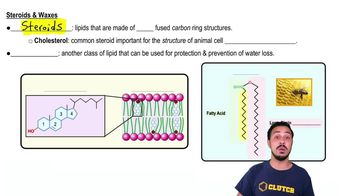
A phospholipid has a hydrophilic head and two hydrophobic fatty acid tails, making it amphipathic.
Having both hydrophilic (water-attracting) and hydrophobic (water-repelling) parts in the same molecule.
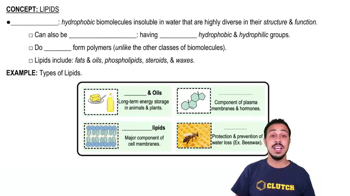
Lipids are generally nonpolar and insoluble in water but soluble in organic solvents.
The bilayer is selectively permeable, allowing small nonpolar molecules to pass but restricting ions and large polar molecules.
Movement of molecules across a membrane against their concentration gradient using energy (ATP).
Movement of molecules down their concentration gradient without energy input.
Includes diffusion, facilitated diffusion, and osmosis.
A simple sugar and the basic unit of carbohydrates, e.g., glucose, fructose.
Common formula is \(C_6H_{12}O_6\) for glucose and fructose.
A carbohydrate polymer made of many monosaccharides linked together.
Starch (energy storage in plants), glycogen (energy storage in animals), cellulose (structural support in plants).
A large molecule made of repeating smaller units called monomers.
A nucleotide consists of a phosphate group, pentose sugar, and a nitrogenous base.
Adenine pairs with thymine, and cytosine pairs with guanine via hydrogen bonds.
DNA strands run in opposite directions: one 5' to 3', the other 3' to 5'.
RNA is a single-stranded nucleic acid that helps in protein synthesis.
Protons and neutrons are in the nucleus; electrons orbit the nucleus.
Polar bonds have unequal electron sharing; non-polar bonds share electrons equally.
Peptide bonds link amino acids in proteins.
Hypertonic: higher solute outside; hypotonic: lower solute outside; isotonic: equal solute concentration.
Enzymes are biological catalysts that speed up reactions and are specific to substrates.
Includes nucleus (DNA storage), mitochondria (energy), ribosomes (protein synthesis), and others.
Gap junctions allow communication between cells; tight junctions prevent leakage between cells.
Hormones travel through blood to distant targets; neurotransmitters act locally at synapses.
Process by which plants convert light energy into chemical energy (glucose).
In the chloroplasts of plant cells.
Light dependent produces ATP and NADPH; light independent (Calvin cycle) produces glucose.
Endergonic reactions require energy input; exergonic reactions release energy.
Process of breaking down glucose to produce ATP.
Glycolysis (cytoplasm), Krebs cycle (mitochondrial matrix), electron transport chain (inner mitochondrial membrane).
Oxidized molecules lose electrons; reduced molecules gain electrons.