 Back
BackGeneral Biology Key Concepts
 01:35
01:35
Terms in this set (31)
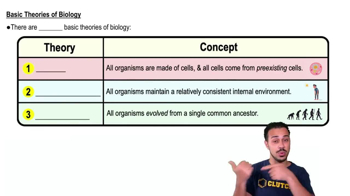
Organization, information, energy and matter, interaction, evolution are the central themes that unify biological study.
Approach that breaks complex systems into simpler components to understand biology.
New properties that arise at each level of biological organization, not present at lower levels.
Study of interactions among components of biological systems to understand their function as a whole.
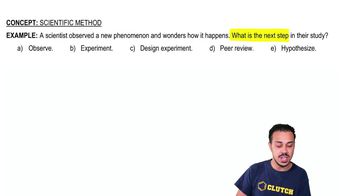
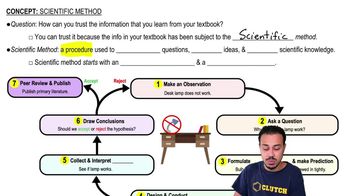
Process involving observation, hypothesis, experimentation, and conclusion to test ideas scientifically.
Deriving general principles from specific observations.
Using general principles to predict specific outcomes.
A testable explanation for a set of observations.
A well-substantiated explanation supported by a large body of evidence.
Basic unit of matter composed of protons, neutrons, and electrons.
Atoms of the same element with different numbers of neutrons.
Strong bond formed by sharing one or more pairs of valence electrons between atoms.
Measure of an atom's ability to attract electrons in a chemical bond.
Bond formed when one atom donates electrons to another, creating oppositely charged ions.
Weak attraction between a hydrogen atom and an electronegative atom in another molecule.
Process that changes reactants into products by making or breaking chemical bonds.
Attraction between water molecules due to hydrogen bonding, important for transport in plants.
Measures acidity or basicity of a solution; ranges from 0 (acidic) to 14 (basic), with 7 neutral.
Substance that minimizes changes in pH by accepting or donating hydrogen ions.
Large molecule formed by polymerization of smaller subunits called monomers.
Reaction that links monomers by removing a water molecule.
Reaction that breaks polymers into monomers by adding water.
Macromolecules including monosaccharides, disaccharides, and polysaccharides used for energy and structure.
Hydrophobic molecules including fats, phospholipids, and steroids important for energy storage and membranes.
Polymers of amino acids that perform diverse functions; structure levels include primary to quaternary.
Polymers of nucleotides that store and transmit genetic information (DNA and RNA).
Cell type without a nucleus, includes bacteria and archaea.
Cell type with a nucleus and membrane-bound organelles.
Network of membranes including nucleus, ER, Golgi apparatus, lysosomes, and vacuoles involved in protein and lipid processing.
Organelles that generate ATP through cellular respiration.
Network of protein fibers (microtubules, microfilaments, intermediate filaments) that maintain cell shape and enable movement.