 Back
BackGeneral Biology Key Concepts
 09:50
09:50
Terms in this set (29)
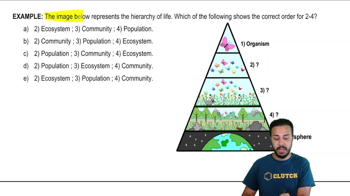
Biosphere is the global ecosystem including all living organisms and their interactions with the atmosphere and environment.
Eukaryotic cells have membrane-bound organelles and a nucleus; Prokaryotic cells lack a nucleus and membrane-bound organelles and are generally smaller.
Gene is a unit of inheritance, a section of DNA on a chromosome that codes for a specific protein or function.
Gene expression is the process of converting information from a gene into its cellular product, typically a protein, often using RNA as an intermediary.
Energy flows through ecosystems entering as light and exiting as heat, while chemicals are recycled within the ecosystem.
Evolution is biological change where organisms gain heritable differences from ancestors, showing descent from a common ancestor.
Observation, question, hypothesis (testable explanation), prediction, experiment, analysis, and conclusion.
Atomic number is the number of protons; mass number is the sum of protons and neutrons in an atom.
Ionic bonds transfer electrons between atoms; Covalent bonds share pairs of valence electrons between atoms.
Water absorbs or releases large amounts of heat with little temperature change due to breaking and forming hydrogen bonds.
Carbohydrates, lipids, proteins, and nucleic acids are the four major classes of biological macromolecules.
The unique sequence of amino acids in a polypeptide chain.
Ribosomes synthesize proteins; rough ER has ribosomes and helps secrete glycoproteins.
Site of cellular respiration, converting oxygen and organic molecules into ATP energy.
Describes the plasma membrane as a mosaic of proteins floating in or on a fluid lipid bilayer.
Passive transport requires no energy and moves substances down their concentration gradient; active transport requires energy to move substances against their gradient.
Ability of a solution to cause a cell to gain or lose water: isotonic (no net movement), hypertonic (cell loses water), hypotonic (cell gains water).
Glycolysis, pyruvate oxidation and citric acid cycle, and oxidative phosphorylation (ETC and chemiosmosis).
Light reactions occur in thylakoid membranes producing ATP and NADPH; Calvin cycle occurs in stroma fixing CO2 into sugars.
Prophase, prometaphase, metaphase, anaphase, telophase, followed by cytokinesis.
Mitosis produces genetically identical diploid cells; meiosis produces genetically diverse haploid gametes through two divisions.
Two alleles for a gene separate during gamete formation, so each gamete carries only one allele.
New DNA strands are synthesized in the 5’ to 3’ direction, antiparallel to the template strand.
DNA is transcribed into RNA, which is translated into protein.
Point mutations include silent, missense, nonsense; insertions or deletions can cause frameshifts.
Operons regulate gene expression by switching genes on or off via operator and promoter regions.
Transmission of gene expression changes without altering the DNA sequence, often via DNA methylation or histone modification.
No evolution occurs if there is random mating, no mutations, no natural selection, large population size, and no gene flow.
Directional, disruptive, and stabilizing selection affect allele frequencies by favoring different phenotypes.