Skip to main content
General Biology
My Course
Learn
Exam Prep
AI Tutor
Study Guides
Textbook Solutions
Flashcards
Explore
Try the app
My Course
Learn
Exam Prep
AI Tutor
Study Guides
Textbook Solutions
Flashcards
Explore
Try the app
Back
General Biology Key Concepts
You can tap to flip the card.
Cell
You can tap to flip the card.
👆
Cell
The basic structural and functional unit of all living organisms.
Track progress
Control buttons has been changed to "navigation" mode.
1/29
Recommended videos
09:50
Life's Organizational Hierarchy
27554
views
653
rank
9
comments
04:05
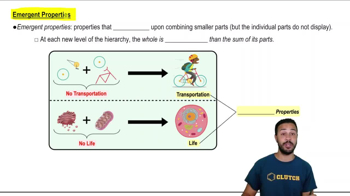
Emergent Properties
17860
views
436
rank
1
comments
03:05
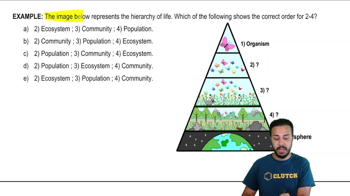
Life's Organizational Hierarchy Example 1
15915
views
439
rank
1
comments
Terms in this set (29)
Hide definitions
Cell
The basic structural and functional unit of all living organisms.
Tissues
Groups of similar cells working together to perform a specific function.
Organs
Structures composed of two or more tissue types working together for a common task.
Organ systems
Groups of organs working together to perform broad body functions.
Population
A group of individuals of the same species living in a specific area.
Community
All the different populations of living organisms interacting in a given area.
Ecosystem
A community of living organisms interacting with their non-living physical environment.
Producer
An organism that creates its own food from non-living resources like light energy.
Consumer
An organism that obtains energy by eating other organisms.
Homeostasis
The process by which an organism maintains a stable internal environment despite external changes.
Prokaryote
A single-celled organism that lacks a nucleus and membrane-bound organelles.
Eukaryote
An organism whose cells contain a distinct nucleus and membrane-bound organelles.
Hypothesis
A testable, tentative explanation for an observation.
Experiment
A structured test designed to support or refute a hypothesis under controlled conditions.
Control group
The group in an experiment that does not receive the experimental treatment, used for comparison.
Independent variable
The factor in an experiment deliberately manipulated by the researcher.
Dependent variable
The factor measured to observe the effect of the independent variable.
Atom
The fundamental unit of matter, composed of protons, neutrons, and electrons.
Ionic bond
A chemical bond formed by the transfer of electrons between atoms, resulting in electrostatic attraction.
Covalent bond
A chemical bond formed when atoms share one or more pairs of electrons.
pH
A scale measuring the concentration of hydrogen ions in a solution.
Acids
Substances with a pH below 7 that release hydrogen ions in solution.
Bases
Substances with a pH above 7 that accept hydrogen ions or release hydroxide ions.
Carbohydrates
Biological macromolecules made of carbon, hydrogen, and oxygen, used for energy and structure.
Monosaccharides
Simple single-sugar molecules like glucose.
Lipids
Nonpolar, hydrophobic biological molecules including fats, oils, and steroids.
Proteins
Functional biological molecules made up of one or more folded chains of amino acids.
Peptide bond
The covalent bond linking amino acids together in a chain.
Secondary structure of proteins
Localized coiling (\(\alpha\)-helix) or folding (\(\beta\)-sheet) of a polypeptide chain stabilized by hydrogen bonds.
 BackBack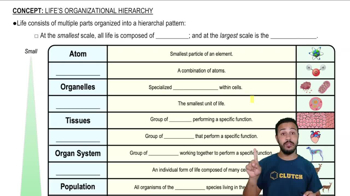
 09:50
09:50